Customer Complaint Handling and Service Recovery: A Practical End-to-End Guide
November 20, 2026 · Research · 8 min read
Written by MATSH Research & Editorial Team · Last updated
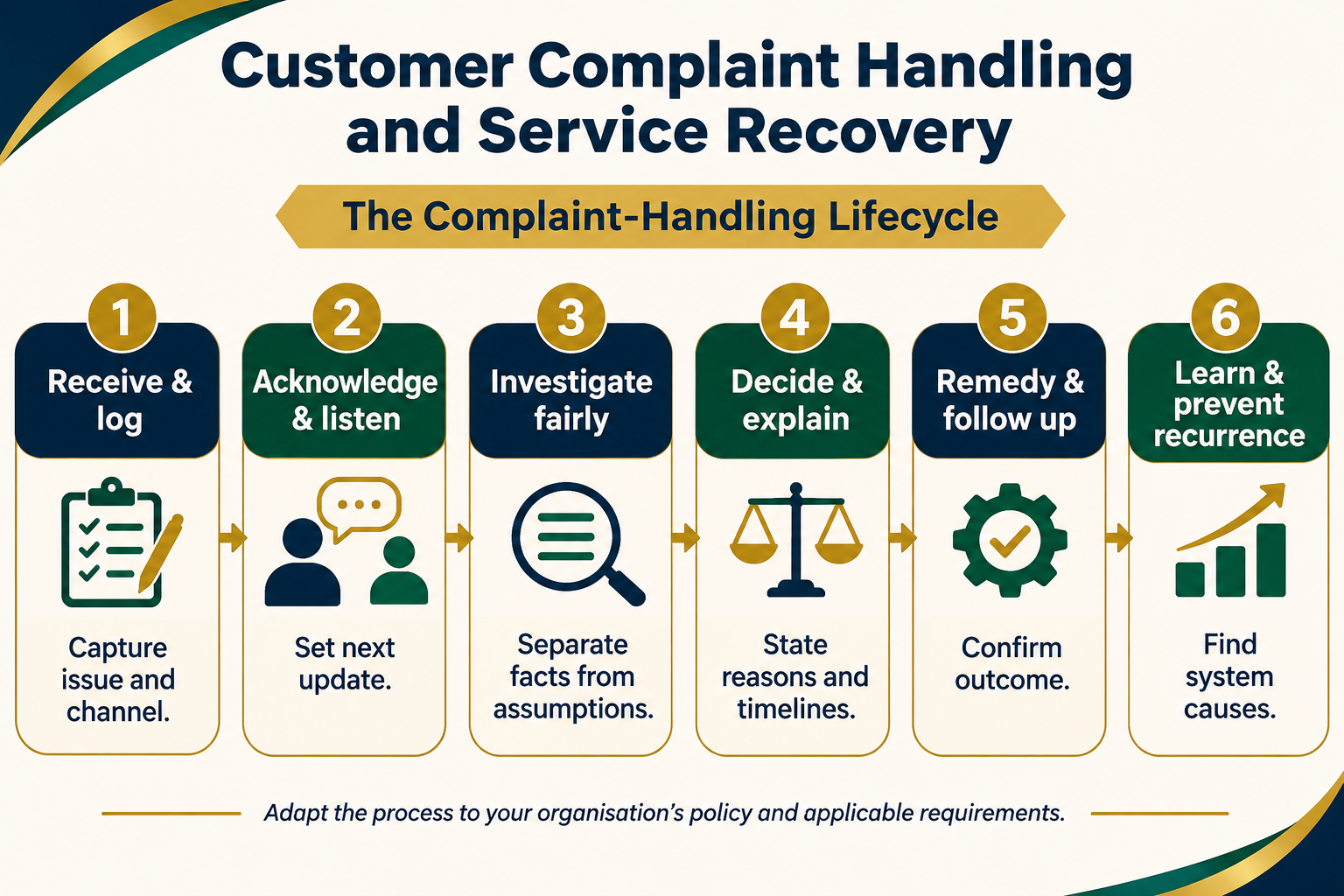
A complaint is not resolved when the customer stops talking. It is resolved when the issue has been addressed, the decision is clear and the organisation has learned what failed.
Strong complaint handling combines empathy with evidence. The frontline employee needs to reduce friction and show ownership without making promises they cannot keep. The organisation then needs a fair investigation, clear authority, proportionate recovery and a response the customer can understand.
ISO 10002:2018 remains the current international guideline for complaints handling and was reviewed and confirmed in 2023. ISO describes complaint handling as a managed process covering planning, design, operation, maintenance and improvement, with customer focus, effective access, analysis, auditing and management review.
Source: ISO 10002:2018, current edition

1. Recognise what kind of contact you are handling
| Contact | Meaning |
|---|---|
| Enquiry | Customer needs information or clarification. |
| Feedback | Customer shares a view without necessarily seeking remedy. |
| Complaint | Customer expresses dissatisfaction and expects response/resolution. |
| Dispute | Parties materially disagree after the complaint process or on rights/obligations. |
2. Build an easy complaint intake process
ISO 10002 emphasises an open and easy-to-use complaints process. Customers should not need to know the internal organisation chart before raising a problem.
Capture at intake
- Customer/contact details
- Date/channel
- Product/service/transaction
- What happened
- Customer impact
- Desired resolution
- Urgency / safety / regulatory flag
- Owner
- Next promised update
3. Acknowledge impact without deciding liability too early
Customer says: “Your team ruined our event.”
Weak response: “That was not our fault.”
Stronger opening: “I can hear how serious this was for you. I want to understand exactly what happened and what we can do next.”
This acknowledges the experience without making a premature factual or legal conclusion.
4. De-escalate before investigating
Listen
Allow the customer to explain the issue without unnecessary interruption.
Reflect
Summarise the issue and impact in neutral language.
Clarify
Ask targeted questions once the core issue is clear.
Set expectations
Explain what happens next and when the customer will hear back.
5. Set boundaries for abusive behaviour
Customer frustration does not require staff to accept threats, discrimination or abuse. Define how employees warn, pause or end interactions while preserving the complaint itself for proper review.
6. Separate allegation, fact and interpretation
| Type | Example |
|---|---|
| Allegation | “The employee deliberately ignored me.” |
| Fact/evidence | Customer waited 28 minutes after check-in. |
| Interpretation | Delay was caused by deliberate neglect. |
7. Build a complaint chronology
Chronology fields
- Date/time
- Event
- Source/evidence
- Person/system involved
- What was communicated
- What decision followed
8. Gather the minimum evidence needed for a fair decision
Orders, tickets, timestamps, transaction records.
Customer account, staff account, supervisor input.
Service promise, terms, operational standard.
Photos, damaged item, delivery evidence, CCTV where appropriate.
9. Investigate proportionately
A small, clear service failure should not wait three weeks for a committee. A complex complaint involving safety, fraud, discrimination or regulatory risk may require formal escalation and specialist review.
10. Use decision consistency without becoming mechanical
| Decision factor | Question |
|---|---|
| Failure | What standard was not met? |
| Impact | What harm/inconvenience occurred? |
| Customer contribution | Did customer action materially affect outcome? |
| Recoverability | Can service/product be corrected? |
| Precedent/policy | How were comparable cases handled? |
| Risk | Does the case require specialist escalation? |
11. Define resolution authority levels
Low-cost correction, small goodwill, replacement within clear limits.
Higher-value remedy, exceptions or repeated failure.
Legal, regulatory, safety, fraud or reputational risk.
12. Give frontline staff enough authority to recover simple failures
Customers become more frustrated when every minor remedy requires multiple transfers. Define clear monetary and non-monetary authority boundaries with escalation when exceeded.
13. Separate correction, remedy and goodwill
| Response | Purpose |
|---|---|
| Correction | Fix the failed product/service. |
| Remedy | Address the customer’s loss/impact where appropriate. |
| Goodwill | Recognise inconvenience/relationship impact beyond strict obligation. |
14. Do not compensate automatically
Money is not always the recovery the customer values most. Fast correction, replacement, clear explanation, acknowledgement or preventing recurrence can matter more.
15. Match recovery to the failure
Missed delivery for a business-critical item
A small voucher may feel dismissive if the real problem is operational disruption. A stronger recovery could include expedited replacement, proactive status ownership, clear explanation, and where policy allows, proportionate compensation tied to the actual impact.
16. Write apologies that are specific
“We apologise for any inconvenience” often sounds procedural. Where appropriate, identify the failure and its impact: “We failed to deliver at the agreed time, and that disrupted your installation schedule.”
17. Explain rejected requests clearly
| Weak response | Stronger response |
|---|---|
| “Policy does not allow it.” | Explain the finding, the relevant rule and what alternative can be offered. |
| “We disagree.” | Summarise evidence and reasoning respectfully. |
| “Case closed.” | Explain closure and any available next step/escalation route. |
18. Build an escalation matrix
Escalate when complaints involve:
- Safety or serious harm
- Fraud/corruption allegation
- Discrimination/harassment
- Data/privacy incident
- Regulatory/statutory issue
- Major financial exposure
- Executive/media/reputational risk
- Repeated systemic failure
19. Transfer ownership without abandoning the customer
When a specialist team takes over, tell the customer who owns the case, what happens next and when they should expect contact. Internal handoff should not feel like customer abandonment.
20. Handle social-media escalations with the same evidence discipline
Public visibility can create pressure for instant compensation or defensive replies. Move personal details to an appropriate channel, acknowledge promptly and investigate using the normal complaint framework.
21. Maintain confidentiality
Complaint records may contain personal, financial, health or employee information. Limit access to what the investigation and response require.
22. Use a written-response standard
Formal response structure
- What complaint was considered
- What evidence was reviewed
- What was found
- What the organisation decided
- What remedy/action will occur
- What happens next
- Any escalation/review route
23. Close only after communicating the outcome
An internal system status of “resolved” is not meaningful if the customer has not been told what was decided. Use separate statuses for investigation complete, remedy completed and customer informed if needed.
24. Confirm promised recovery actions
Do not promise expedited delivery, refund, service credit or manager call unless the responsible team has accepted the commitment.
25. Capture root-cause information before closure
| Case field | Use |
|---|---|
| Primary complaint category | Trend analysis |
| Failure cause | Operational improvement |
| Severity | Risk prioritisation |
| Recovery used | Consistency/cost analysis |
| Repeat issue? | Systemic problem detection |
26. Review whether the recovery restored trust
Customer satisfaction after complaint closure can be useful, but do not pressure customers for positive ratings. More useful evidence may include repeat contact, escalation, retention or whether the same issue recurs.
27. Train managers to coach complaint decisions
Review sample cases for evidence quality, tone, authority, remedy and escalation. Do not coach only on average handling time.
Common complaint-handling mistakes
28. Define acknowledgement and resolution service levels separately
Customers need quick confirmation that the complaint has been received, but complex cases may require more time to investigate. Publish realistic service levels and give updates when the final decision will take longer.
| Stage | Control |
|---|---|
| Acknowledgement | Confirm receipt, owner and next step. |
| Investigation | Gather facts and assess policy/service standard. |
| Interim update | Explain progress if target resolution cannot be met. |
| Final response | Finding, remedy/action and escalation route. |
29. Use service-recovery tiers
Simple correction or explanation within frontline authority.
Supervisor remedy, replacement, credit or exception.
Complex/high-value case requiring specialist review.
Safety, regulatory, fraud, legal or major reputational issue.
30. Define recovery guardrails
Guardrails should cover:
- Maximum frontline goodwill value
- Refund/replacement authority
- When manager approval is mandatory
- When legal/compliance review is mandatory
- When evidence must be preserved
- When customer communication needs formal sign-off
31. Separate apology from legal admission
Employees should not avoid all apologies because they fear “admitting liability”. The organisation can define language that acknowledges experience and service failure appropriately while routing legal questions to qualified reviewers when necessary.
32. Handle incomplete evidence explicitly
Some complaints cannot be proven conclusively. State what evidence was available, what remains uncertain and how the organisation reached a fair decision. Do not invent certainty.
Conflicting customer and staff accounts
No call recording exists. The system confirms the timing but not the words used. A strong response explains which facts are established, which are disputed and what service improvement will occur regardless, such as restoring call recording or clarifying the script.
33. Manage repeated or unreasonable contact proportionately
Some customers repeat the same resolved complaint through multiple channels or contact staff abusively. Define when the organisation may consolidate communication, require one contact route or set boundaries, while preserving any genuinely new issue.
34. Separate complaint handling from external dispute resolution
ISO 10002 concerns complaint handling within the organisation. If a customer escalates to an ombudsman, regulator, court or other external forum, sector-specific procedures may apply. The internal process should explain available next steps without pretending to replace them.
35. Use complaint handoff standards
| Handoff field | Purpose |
|---|---|
| Issue summary | Prevents customer repetition. |
| Evidence collected | Avoids duplicate investigation. |
| Customer expectation | Prevents conflicting promises. |
| Next action | Clarifies ownership. |
| Deadline | Protects timeliness. |
36. Review compensation consistency
Analyse similar cases to detect arbitrary or biased recovery. Consistency does not mean identical remedies, but material differences should have a reason linked to impact or circumstances.
37. Measure promise completion
Track whether promised actions actually occurred:
- Refund processed
- Replacement delivered
- Manager call completed
- Account correction posted
- Process fix assigned
- Customer informed
38. Use complaint quality calibration
Supervisors should periodically review the same sample cases and compare decisions. Large differences reveal unclear policy, weak authority rules or training gaps.
Resolve the customer issue and improve the process that created it
MATSH’s Customer Complaint Handling and Service Recovery Course covers intake, de-escalation, investigation, remedy, escalation, response writing, complaint analytics and continuous improvement.
Explore Sales, Customer Relations & Negotiation
Explore the Complaint Handling course
Register
Sources
Need In-House Training?
We run all our courses as private programmes for organisations across the GCC and Africa.
Request In-House →