
Strategic Foresight and Scenario Planning Course
Build strategic foresight capability through horizon scanning, drivers of change, critical uncertainty, scenario construction, wind-tunnelling, strategic options and future signposts. Includes applied scenario work and strategy decision tools.
View all 16 schedules
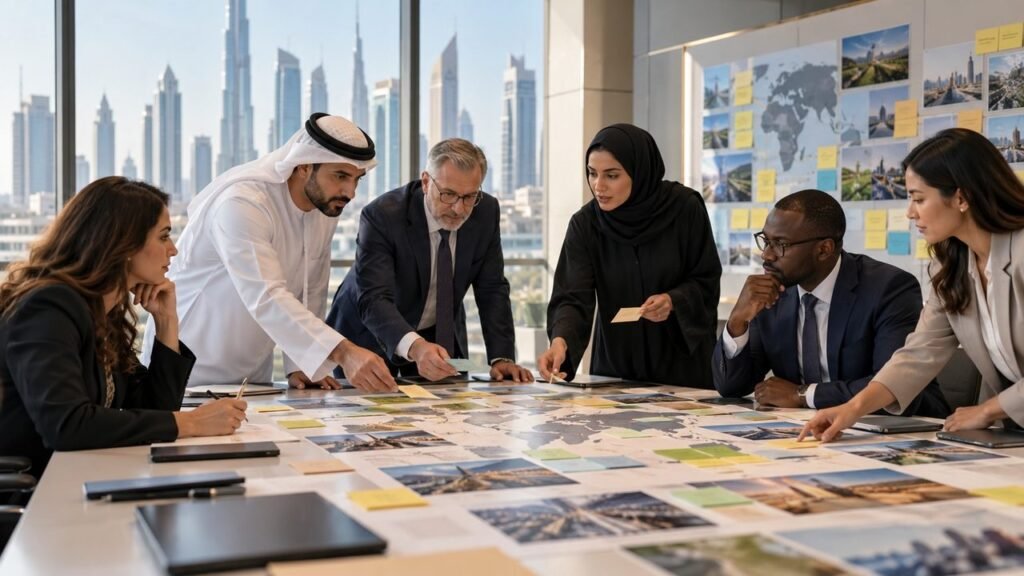
Strategic Planning Asks What We Should Do. Foresight First Asks What Kind of World We May Be Doing It In.
Most strategy processes begin with evidence from the present: market size, competitors, regulation, customer behaviour, capabilities, budgets and current risks. That is necessary, but it can create a hidden assumption that tomorrow will remain close enough to today for the plan to hold.
Strategic foresight challenges that assumption deliberately.
OECD defines strategic foresight as a structured and systematic approach to exploring plausible futures in order to anticipate and prepare for change. UNDP's 2026 Foresight for Strategic Planning Toolkit likewise emphasises that foresight is not prediction; it expands awareness of what could happen, clarifies assumptions behind today's decisions and helps design actions that remain resilient as conditions change.
This course teaches the practical methods behind that discipline. Participants scan for emerging change, distinguish signals from noise, identify critical uncertainties, build internally coherent scenarios, test current strategies against them, design robust options and establish signposts that indicate which future may be beginning to emerge.
OECD Strategic Foresight · UNDP Foresight Toolkit 2026 · Dubai Future Academy. Evidence is contextual and does not guarantee participant or organisational outcomes.
Strategies become fragile when:
- teams extrapolate historical trends as though disruption will be linear
- a single "base case" becomes the only future leadership discusses
- risk registers list known threats but miss structural change and emerging opportunities
- megatrends are discussed at conferences but never translated into organisation-specific implications
- early signals are noticed individually but there is no structured scanning process
- scenario workshops create imaginative stories that never affect real decisions
- leaders treat uncertainty as a reason to delay rather than a variable to design around
- strategic options are assessed only against today's environment
- organisations overcommit to choices that are expensive to reverse
- plans lack signposts showing when assumptions are becoming invalid
- teams confuse forecasting, risk management and foresight even though they answer different questions.
How This Applies Across the Markets MATSH Serves
GCC
Foresight is increasingly relevant to government transformation, urban development, energy transition, technology, national strategies and rapidly evolving economic diversification agendas. Participants work with uncertainty around technology, demographics, regulation, climate and geopolitical change without assuming one official forecast is the future.
Africa
Applications include infrastructure, youth demographics, climate adaptation, digital markets, public services and development strategies where long investment horizons meet high uncertainty and uneven institutional capacity.
Asia
Participants examine technology acceleration, supply-chain shifts, demographic change, manufacturing transitions, urbanisation and competitive disruption across diverse markets.
Europe
Applications include policy design, energy and climate transition, regulation, technology governance, ageing populations and long-horizon investment where plans need to remain robust across several possible futures. These are contextual lenses, not claims that every organisation in a region faces identical uncertainties.
Who Should Attend
Strategy and Corporate Planning Professionals
Wanting to strengthen conventional planning with structured analysis of uncertainty.
Senior Leaders and Executives
Making choices whose consequences extend beyond the reliability of short-term forecasts.
Government and Public-Policy Teams
Designing policies and investments expected to remain useful across changing conditions.
Innovation and Transformation Leaders
Tracking emerging change and translating it into strategic options.
Risk and Resilience Professionals
Needing to complement risk registers with exploration of deeper structural uncertainty.
Analysts and Foresight Practitioners
Building a repeatable, decision-linked foresight process rather than one-off futures workshops.
What You Will Leave With
A complete foresight-to-strategy process.
Programme Curriculum
Why this module matters: Foresight becomes vague when participants jump directly into imaginative scenarios. Strong work begins with disciplined scanning and a clear understanding of what evidence says about emerging change. Participants learn to:
- distinguish forecasting, strategic planning, risk management and foresight
- choose a useful foresight time horizon
- define the focal question and system boundary
- design scanning domains and source categories
- identify trends, megatrends, weak signals, emerging issues and discontinuities
- assess signal relevance and evidence strength
- avoid recency bias and fashionable-topic bias
- build a shared scanning repository
- identify cross-domain interactions rather than analyse signals in isolation
- establish a repeatable scanning cadence and ownership model.
Workshop: Build a horizon-scanning map around one strategic question.
Why this module matters: A long list of trends is not foresight. The analytical step is understanding which forces interact, which are relatively predetermined and which uncertainties could push the system into materially different futures. Participants learn to:
- cluster scan findings into drivers of change
- distinguish relatively predictable drivers from critical uncertainties
- map interactions and reinforcing effects between drivers
- identify assumptions embedded in current strategy
- challenge linear extrapolation
- assess impact and uncertainty without pretending precision
- select uncertainties that genuinely alter strategic choices
- identify wild cards and low-probability/high-impact disruptions without allowing them to dominate every scenario
- construct system maps at a level decision-makers can use
- frame the scenario question precisely.
Workshop: Prioritise drivers and critical uncertainties for a real strategic issue.
Why this module matters: Scenarios are useful only when they are plausible, internally coherent and strategically distinct. Four versions of the same future or fictional stories disconnected from evidence do not improve decisions. Participants learn to:
- choose an appropriate scenario architecture
- build scenario logics from critical uncertainties and driver interactions
- maintain internal consistency within each scenario
- distinguish plausible futures from preferred futures
- incorporate predetermined elements without making every scenario identical
- develop scenario narratives that explain causal evolution over time
- describe implications for customers, stakeholders, operations and institutions
- avoid "good / bad / middle" scenario sets
- challenge scenarios with external evidence and diverse perspectives
- communicate scenarios without presenting them as forecasts.
Workshop: Build and present a differentiated scenario set for one focal question.
Why this module matters: Scenario planning creates value only when it changes decisions. Wind-tunnelling exposes which parts of today's strategy remain robust and which rely on one fragile assumption about the future. Participants learn to:
- test current strategy against each scenario
- identify vulnerabilities, opportunities and hidden assumptions
- distinguish no-regret actions from scenario-specific bets
- design contingent options and strategic hedges
- preserve flexibility where uncertainty is high
- identify capabilities valuable across several futures
- compare reversibility and lock-in
- use back-casting from desirable or undesirable futures
- connect scenario insight with investment and portfolio decisions
- translate implications into concrete strategic choices.
Simulation: Stress-test a current strategy against three contrasting future environments.
Why this module matters: Foresight should not end when the workshop closes. Its real value comes from tracking how the environment evolves and revisiting decisions before assumptions become obviously wrong. Participants learn to:
- identify signposts that distinguish scenarios from one another
- build monitoring indicators around critical uncertainties
- establish thresholds for strategic review
- connect scanning updates with leadership decision forums
- maintain scenario sets as living strategic assets
- document changes in assumptions
- integrate foresight into annual strategy, risk and investment cycles
- use AI-assisted scanning and synthesis cautiously, with attention to reliability, transparency and bias
- create a foresight community or ownership model
- define an organisational foresight maturity roadmap.
Capstone: Present a complete foresight pack with scans, scenarios, wind-tunnelling results, strategic options and signposts.
Common Questions
The Goal Is Not to Know the Future. It Is to Stop Building Strategy That Only Works in One Version of It.
Build the foresight capability to detect change earlier, explore plausible futures and design choices that remain useful when conditions shift.
📅 Upcoming Schedules — View dates and locations ▾
We run this course as a private programme for organisations. Bespoke dates, tailored content, group pricing.
Every course starts with a needs assessment and includes structured follow-up at three points after it ends.
Related Courses
Anti-Bribery and Corruption Compliance Course → Customer Complaint Handling and Service Recovery Course → Key Account Management Course → Data Protection and Privacy Compliance for GCC Organisations Course →Have a question about this course?
Get in Touch