Female Participation in Business Ownership in GCC and Africa: World Bank Firm Statistics
November 19, 2026 · Research, Women Empowerment · 4 min read
Written by MATSH Research & Editorial Team · Last updated
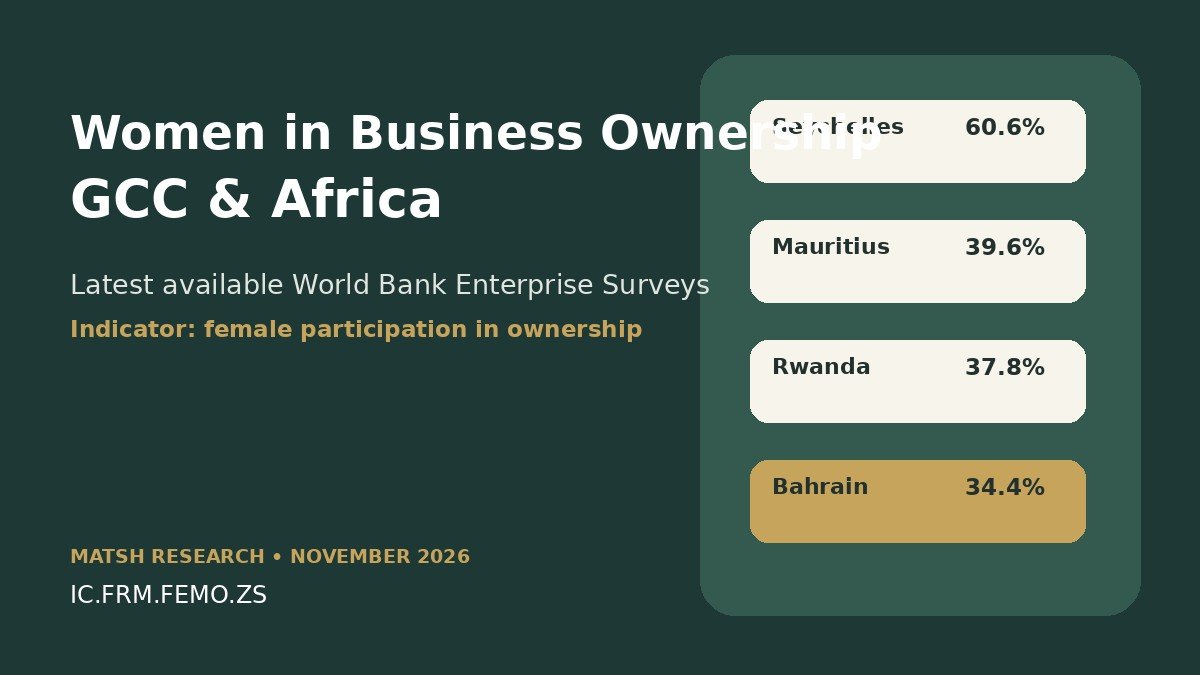
How many private-sector firms have women among their owners? The World Bank Enterprise Surveys track that question through indicator IC.FRM.FEMO.ZS, “Firms with female participation in ownership (% of firms).” The latest available results show large differences across GCC and African economies, but the measure is frequently misunderstood.
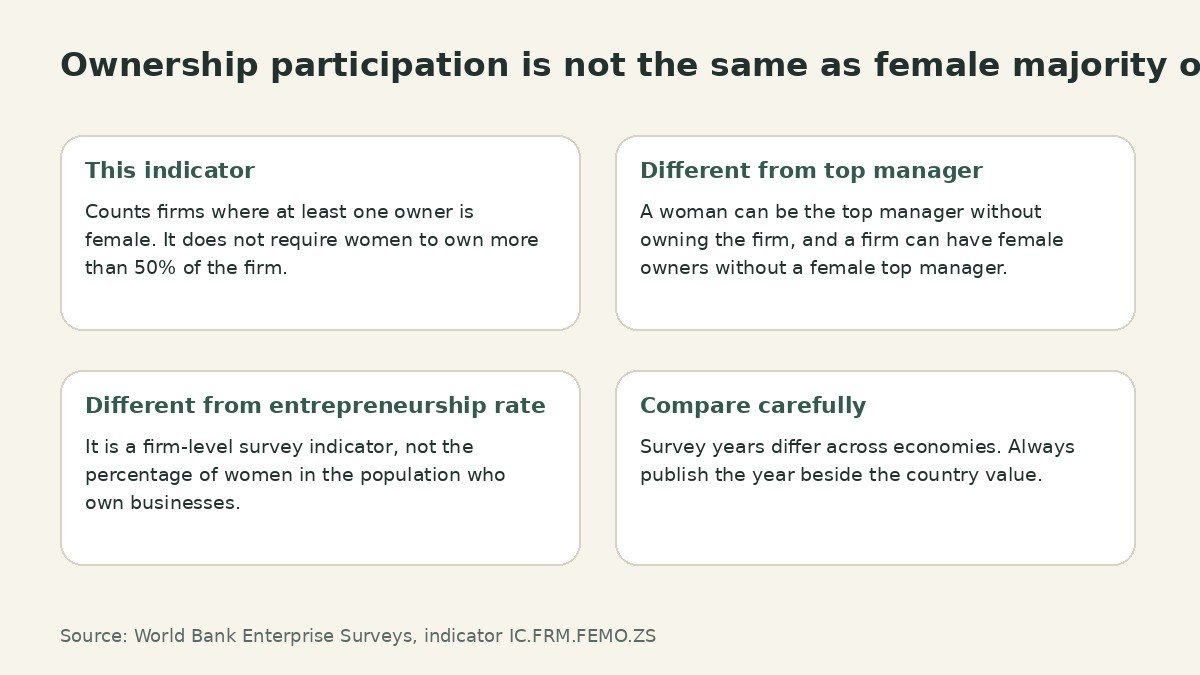
“Female participation in ownership” does not mean majority female ownership. A firm is counted when women participate in ownership, even if men also own part of the business. It is also separate from having a female chief executive or top manager. This report keeps those distinctions explicit and shows the survey year beside every country value.
Download the selected-country CSV
What “female participation in ownership” means
The World Bank indicator measures the percentage of surveyed private-sector firms in which women participate in ownership. It is a broad ownership-presence measure. A business with one female co-owner can be counted even when women do not hold a majority stake.
GCC country data
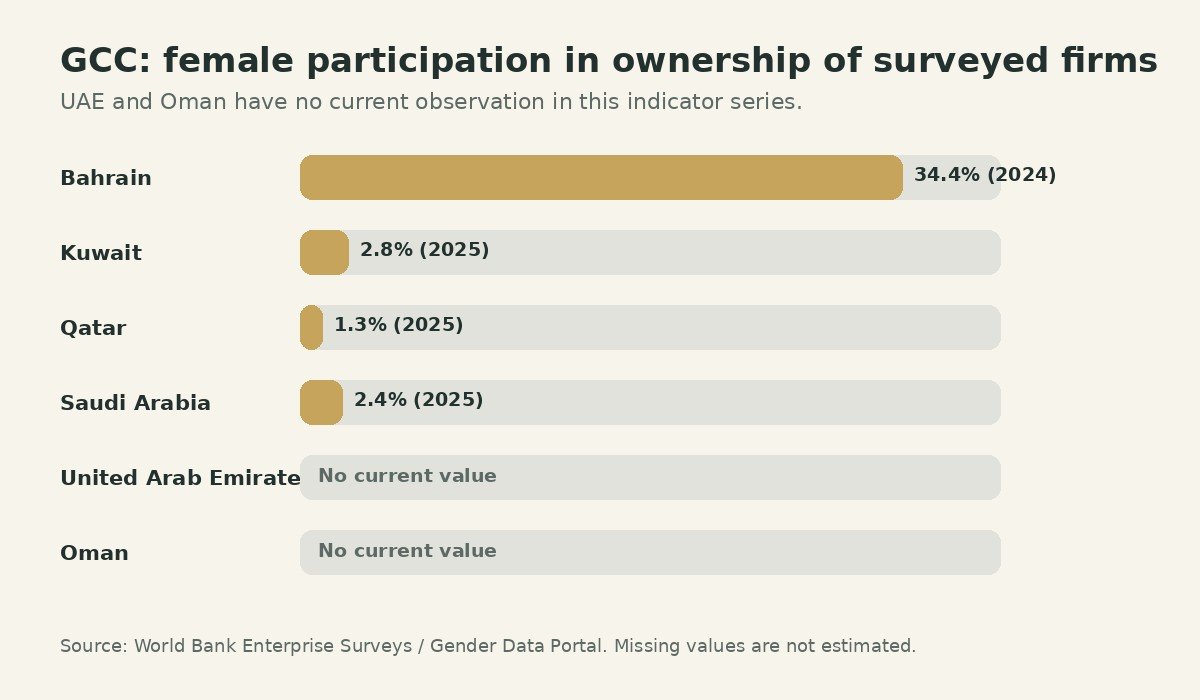
Recent World Bank Enterprise Survey observations are available for Bahrain, Kuwait, Qatar and Saudi Arabia. The current series does not provide a comparable value for the UAE or Oman, so those countries are shown as unavailable rather than estimated.
| GCC economy | Latest year shown | Firms with female participation in ownership |
|---|---|---|
| Bahrain | 2024 | 34.4% |
| Kuwait | 2025 | 2.8% |
| Saudi Arabia | 2025 | 2.4% |
| Qatar | 2025 | 1.3% |
| United Arab Emirates | — | Not available |
| Oman | — | Not available |
The spread in the available GCC values should be interpreted cautiously. Survey timing, firm populations and business structures differ. The indicator does not measure informal entrepreneurship, sole proprietorships outside the survey frame, or the total number of women entrepreneurs in the economy.
Selected African economies
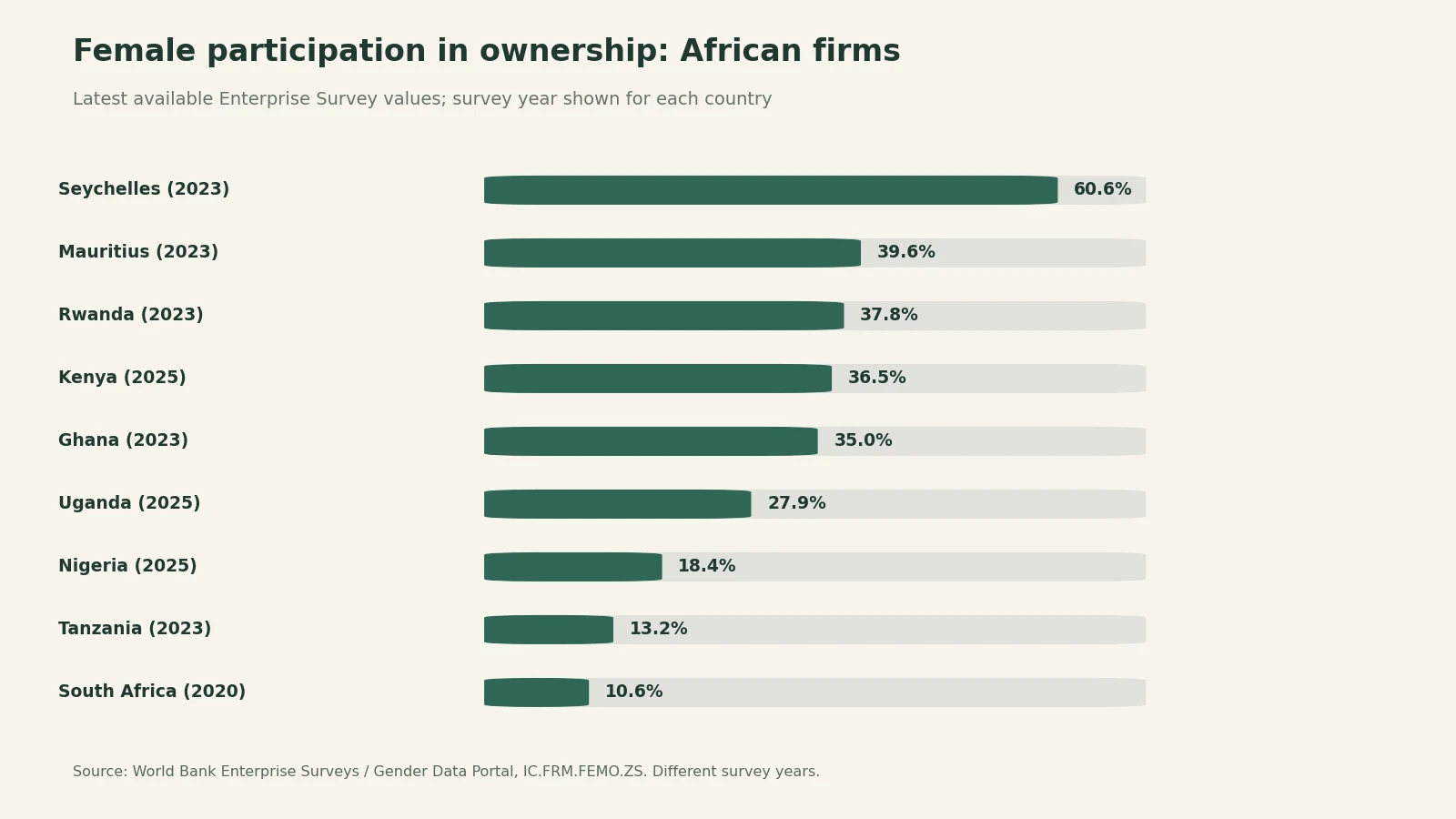
African results also vary substantially. Seychelles has the highest value among the selected economies in this compilation, while the latest South African observation in this series is much lower. The values should not be treated as a single-year ranking because the underlying surveys were conducted in different years.
| Economy | Latest year shown | Firms with female participation in ownership |
|---|---|---|
| Seychelles | 2023 | 60.6% |
| Mauritius | 2023 | 39.6% |
| Rwanda | 2023 | 37.8% |
| Kenya | 2025 | 36.5% |
| Ghana | 2023 | 35.0% |
| Uganda | 2025 | 27.9% |
| Nigeria | 2025 | 18.4% |
| Tanzania | 2023 | 13.2% |
| South Africa | 2020 | 10.6% |
Why ownership and management should be analysed separately
A firm can have female owners without having a woman as its top manager, and a woman can lead a firm without owning any of it. The two World Bank indicators therefore describe different parts of economic participation.
For example, this ownership measure reports 60.6% for Seychelles in 2023, while the separate female top-manager measure reports 26.3% for Seychelles in the same year. The gap does not imply a problem by itself, but it shows why ownership presence should not be used as a proxy for executive leadership.
What organisations and programme designers can learn
Country-level ownership data can help governments, development programmes, financial institutions and business-support organisations identify questions worth investigating. It cannot diagnose the constraint by itself. A lower observed share may relate to access to finance, legal and administrative barriers, sector mix, business size, market access, social norms, care responsibilities, business formalisation or other factors.
Women’s entrepreneurship programmes should therefore avoid assuming that training is always the missing input. MATSH’s guide on women’s entrepreneurship: training vs market access vs finance explains why programme design needs to diagnose whether the binding problem is capability, customers, capital, networks, regulation or another constraint.
For funders and public programmes
When designing an entrepreneurship programme, use this indicator as one contextual input alongside measures of business survival, firm size, revenue, access to finance, procurement access, employment creation and sector participation. A programme that only counts how many women attended business training may show strong activity while telling very little about enterprise outcomes.
Related MATSH resources include diagnosing barriers in women’s economic empowerment programmes, Women’s Entrepreneurship Programme Design and Management, and the broader women empowerment course portfolio.
Methodology and limitations
- Indicator: IC.FRM.FEMO.ZS, Firms with female participation in ownership (% of firms).
- Primary source: World Bank Enterprise Surveys.
- Unit: percentage of surveyed private-sector firms.
- Meaning: female participation in ownership, not necessarily majority female ownership.
- Timing: survey years differ by economy and are shown beside each figure.
- Missing data: no value is estimated where the current World Bank series reports no observation.
- Compilation date: 12 November 2026.
Primary sources
How to cite this page
Suggested citation: MATSH People Development (2026), “Female Participation in Business Ownership in GCC and Africa: World Bank Firm Statistics.” When quoting an economy, include its survey year and cite the World Bank Enterprise Surveys as the primary data source.
Need In-House Training?
We run all our courses as private programmes for organisations across the GCC and Africa.
Request In-House →