Key Account Selection and Strategic Account Planning: A Practical KAM Framework
November 20, 2026 · Research · 8 min read
Written by MATSH Research & Editorial Team · Last updated
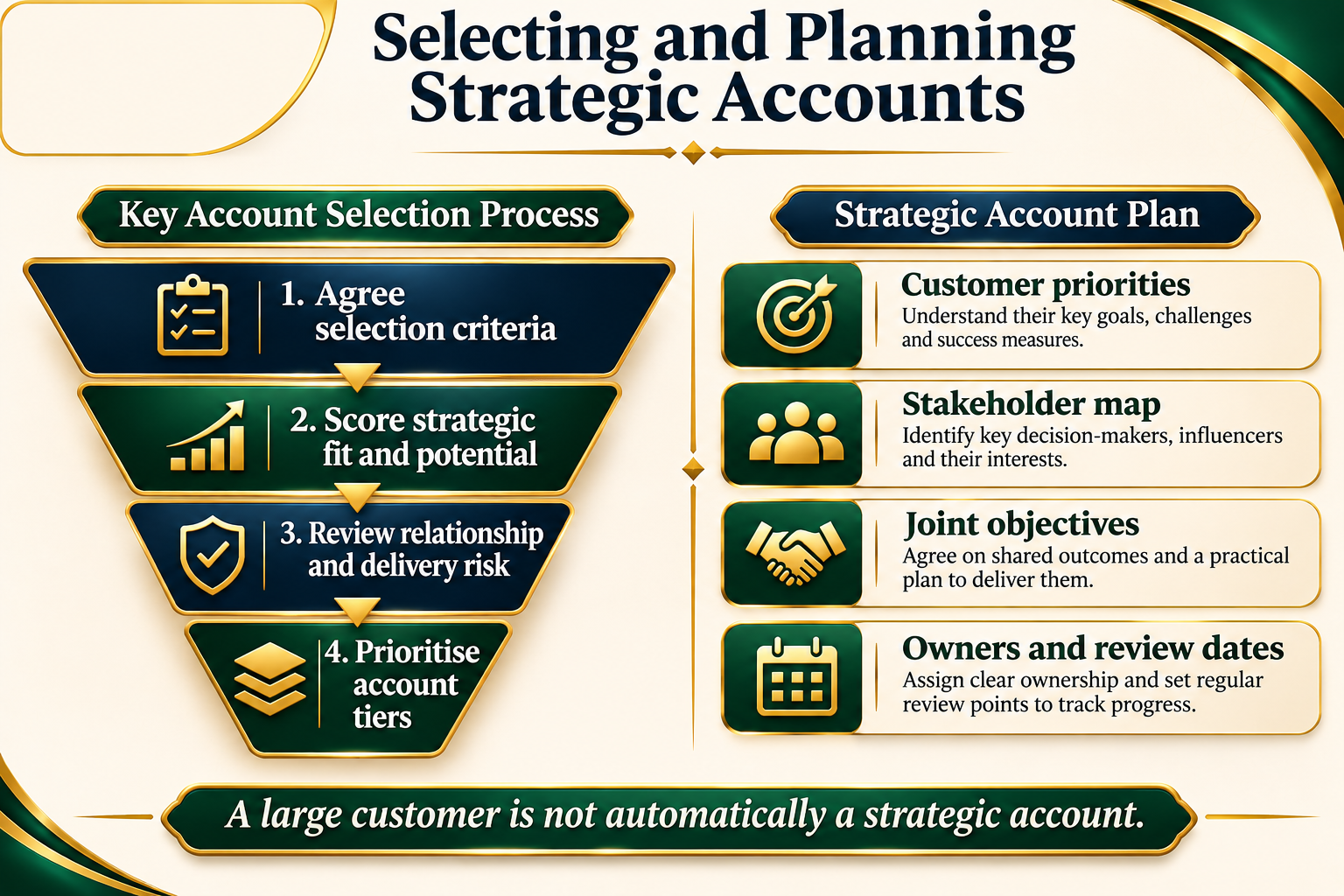
A key account is not simply a customer with a large invoice. It is a customer important enough to justify a different management system.
Strategic account management starts with disciplined selection. If every large customer becomes “strategic”, account teams spread executive attention, specialist resources and investment too thinly. The organisation needs a transparent way to decide which relationships deserve cross-functional planning, executive sponsorship and long-term value creation.
SAMA’s 2026 strategic-account curriculum emphasises value co-discovery, internal and external alignment, authentic customer relationships and the strategic account plan as a management tool rather than a reporting form. Its 2026 conference material also frames the account plan as a business plan that should guide revenue growth and relationship expansion.
Source: SAMA, Value Co-Discovery and Strategic Account Planning · Source: SAMA, Account Growth Strategies, 2026

1. Define what “key” means in your business
| Criterion | Question |
|---|---|
| Current economic value | What revenue, margin and cash value does the account contribute? |
| Future growth potential | Is there credible whitespace, geographic or solution expansion? |
| Strategic fit | Does the account align with where the supplier wants to compete? |
| Relationship potential | Will the customer collaborate beyond transactional purchasing? |
| Complexity | Does the relationship require cross-functional coordination? |
| Risk | How exposed is the supplier to loss, concentration or service burden? |
2. Separate major accounts from strategic accounts
Large current value, but limited strategic collaboration or growth potential.
Mutual importance, complex relationship and credible long-term value potential.
Smaller today but strong future fit and expansion opportunity.
Profitable and valuable, but does not justify dedicated SAM infrastructure.
Strategic-account status should be earned across several criteria, not awarded by revenue alone.
3. Use a weighted selection model
Possible criteria
- Revenue/margin
- Growth potential
- Strategic alignment
- Innovation potential
- Customer willingness to collaborate
- Reference/market influence
- Relationship access
- Cost-to-serve
- Risk/concentration
4. Avoid letting one criterion dominate automatically
A very large customer with shrinking margin, high service cost and limited collaboration may deserve tight commercial management but not a full strategic-account investment model.
Largest customer scores poorly on strategic fit
Customer A is 12% of revenue but buys only commoditised services, runs constant price tenders and allows little executive access. Customer B is 5% of revenue, growing quickly, collaborates on innovation and operates in the supplier’s priority sectors.
Both matter, but they may need different account models rather than identical “key account” treatment.
5. Define the investment level by account tier
| Tier | Possible management model |
|---|---|
| Strategic | Dedicated KAM, executive sponsor, cross-functional team, formal plan |
| Key | Named account owner, periodic cross-functional reviews |
| Growth | Focused development plan and opportunity investment |
| Core/transactional | Efficient sales/service coverage |
6. Start the account plan with customer strategy
SAMA’s current planning model begins with understanding what matters to the customer, including external pressures, objectives, plans, internal challenges and measures of success. The account plan should therefore explain the customer’s business before it explains the supplier’s pipeline.
7. Map the customer’s business model
Capture:
- How the customer creates value
- Revenue/cost pressures
- Strategic priorities
- Regulatory/market pressures
- Investment priorities
- Critical capabilities
- Major change programmes
- Customer’s own customer needs
8. Translate customer priorities into account hypotheses
| Customer priority | Account hypothesis |
|---|---|
| Reduce service downtime | Supplier may create value through predictive maintenance/service redesign |
| Expand to new geography | Supplier may support deployment, compliance or local capability |
| Lower operating cost | Supplier may redesign process rather than discount unit price |
| Improve customer retention | Supplier may contribute data, service or experience capability |
9. Map the stakeholder network
Strategic accounts are rarely managed through one buyer. Map economic, technical, operational and executive stakeholders, plus internal influencers and blockers.
Owns budget or business case.
Evaluates capability and risk.
Experiences day-to-day value or pain.
Connects the relationship to strategic priorities.
Controls commercial process and terms.
10. Score relationship strength honestly
| Relationship state | Evidence |
|---|---|
| Unknown | No direct access or useful information |
| Contact | Transactional interaction only |
| Supporter | Positive engagement but limited influence |
| Sponsor | Advocates internally and helps navigate decisions |
| Strategic partner | Collaborates on shared outcomes and future agenda |
11. Identify relationship concentration risk
If the supplier’s entire account knowledge sits with one account manager and one customer contact, the relationship is fragile. Build multiple relevant connections across levels and functions.
12. Build an opportunity portfolio, not one giant pipeline
Separate:
- Current contracted business
- Renewal/retention actions
- Near-term qualified opportunities
- Strategic growth initiatives
- Co-innovation bets
- Longer-term whitespace hypotheses
13. Balance short-term and long-term objectives
SAMA’s current account-planning material explicitly highlights balancing short- and long-term priorities. A good plan protects today’s revenue while developing future value.
14. Turn objectives into specific account moves
| Objective | Weak action | Stronger action |
|---|---|---|
| Build executive relationship | Arrange executive meeting | Prepare a joint strategic agenda around customer priority X and evidence Y |
| Grow account | Cross-sell services | Validate three whitespace hypotheses with operational sponsors |
| Reduce risk | Improve service | Close top three recurring service failures before renewal |
15. Assign the internal account team
Owns the overall account system.
Supports strategic access and senior alignment.
Shapes technical/value opportunities.
Delivers current value and resolves structural issues.
Tracks economics, terms and profitability.
16. Use internal alignment before customer commitments
Strategic account teams damage trust when sales promises outcomes operations cannot deliver. Validate capacity, margin and delivery implications before major commitments.
17. Make the account plan a living management tool
Monthly
Update actions, opportunity evidence and stakeholder change.
Quarterly
Review objectives, economics, risks and relationship health.
Annually
Revalidate strategic-account status and investment level.
18. Track assumptions explicitly
| Assumption | Validation |
|---|---|
| Customer will expand into Region X | Executive statement / investment plan |
| Procurement will consolidate suppliers | Sourcing programme evidence |
| Customer values faster implementation | Discovery with operational/economic stakeholders |
19. Review account economics
Revenue growth can hide margin erosion and increasing service burden. Track contribution, discounting, implementation cost, support intensity and working-capital effects where data allow.
20. Track retention risk before renewal
Risk signals
- Executive sponsor leaves
- Recurring service problems
- Procurement launches tender
- Customer strategy changes
- Competitor gains access
- Value proof weakens
- Usage/adoption falls
- Margin or contract tension rises
21. Run a quarterly account business review
| Section | Question |
|---|---|
| Customer | What changed in strategy, people or pressures? |
| Value | What value was delivered and evidenced? |
| Relationship | Where are access/support gaps? |
| Growth | Which opportunities are validated? |
| Risk | What could cause loss or margin erosion? |
| Actions | What will the team do next? |
22. Requalify accounts periodically
Strategic-account status should not be permanent. Customers change, markets shift and the supplier’s strategy evolves. Move accounts between tiers when evidence changes.
Common key-account planning mistakes
23. Define account-tier governance
Account segmentation only creates value when each tier receives a different operating model. Otherwise the scoring exercise becomes a label with no resource consequence.
| Tier | Governance | Review cadence |
|---|---|---|
| Strategic | Executive sponsor, cross-functional team, formal plan | Monthly team + quarterly executive review |
| Key | Named account owner, selective functional support | Quarterly |
| Growth | Development owner and opportunity hypothesis | Quarterly / milestone-based |
| Core | Efficient commercial/service coverage | Standard portfolio cadence |
24. Build a whitespace map
Whitespace is not simply “products the customer has not bought”. Map business problems, strategic initiatives, geographies, business units and capabilities where the supplier could plausibly create value.
Whitespace fields
- Customer priority
- Business unit / geography
- Current supplier position
- Existing competitor / internal alternative
- Customer problem or opportunity
- Evidence of need
- Potential mutual value
- Next validation step
25. Separate whitespace hypothesis from qualified opportunity
| Stage | Evidence |
|---|---|
| Hypothesis | Potential need inferred from customer strategy |
| Validated need | Relevant customer stakeholder confirms the problem/opportunity |
| Qualified opportunity | Need, value, decision process and timing are credible |
| Committed initiative | Joint action or formal buying process begins |
26. Create a relationship-development plan by gap
Do not schedule meetings just to increase contact volume. For each missing stakeholder, define why the relationship matters, what value the interaction could create and which supplier counterpart should engage.
Strong procurement relationship, weak operations access
The account manager knows procurement well but lacks access to the business unit experiencing the service problem. The plan is not “more executive meetings”. It is to earn operations access by resolving a specific performance issue and bringing the appropriate service leader into the discussion.
27. Build an account risk register
| Risk | Evidence | Mitigation |
|---|---|---|
| Sponsor departure | Leadership transition announced | Broaden relationships before transition |
| Margin erosion | Repeated discount requests | Rebuild value case / scope discipline |
| Service failure | Recurring SLA misses | Root-cause recovery plan |
| Competitor entry | New pilot / tender activity | Validate differentiation and value evidence |
28. Connect the account plan to resource allocation
If an initiative requires solution engineers, executive time, custom development or service investment, show the internal resource request, expected customer value and commercial rationale.
29. Use account review decisions, not presentations
Quarterly review outputs
- Continue / stop / accelerate strategic initiatives
- Change stakeholder coverage
- Approve internal investment
- Escalate service risk
- Reprioritise opportunities
- Reassess account tier if evidence changed
30. Define success beyond annual revenue
| Dimension | Possible evidence |
|---|---|
| Growth | Profitable expansion / share of relevant wallet |
| Value | Customer-confirmed outcomes |
| Relationship | Broader sponsor/supporter network |
| Economics | Margin and cost-to-serve improvement |
| Risk | Lower concentration or renewal risk |
| Strategic position | Earlier involvement in customer initiatives |
Manage key accounts like businesses, not oversized opportunities
MATSH’s Key Account Management Course covers account selection, customer strategy, stakeholder networks, value co-discovery, account planning, growth, retention and account economics.
Explore Sales, Customer Relations & Negotiation
Explore the Key Account Management course
Register
Sources
Need In-House Training?
We run all our courses as private programmes for organisations across the GCC and Africa.
Request In-House →