Youth Employability Programme Design: Diagnose the Labour Market Before You Train
November 21, 2026 · Youth Development · 8 min read
Written by MATSH Research & Editorial Team · Last updated
Youth employment programmes should begin with the barrier between young people and work, not with the training course the organisation already knows how to deliver.
The same employment outcome can be blocked by very different mechanisms: missing occupational skills, weak job-search networks, transport costs, employer screening, lack of work experience, childcare, low labour demand, poor information or a mismatch between location and opportunity. Programme design improves when those mechanisms are diagnosed before the service package is selected.
The joint ILO/World Bank 2026 systematic review draws on 228 studies across 62 countries and more than 5,000 treatment-effect estimates across skills training, entrepreneurship support, employment services, wage subsidies and public works. The World Bank’s 2026 What Works for Work guidebook similarly emphasises contextual tailoring, comprehensive scope, aligned incentives, private-sector engagement and links with social protection.
Source: ILO/World Bank, The Impact of Active Labour Market Programmes on Youth, 2026 · Source: World Bank, What Works for Work, 2026

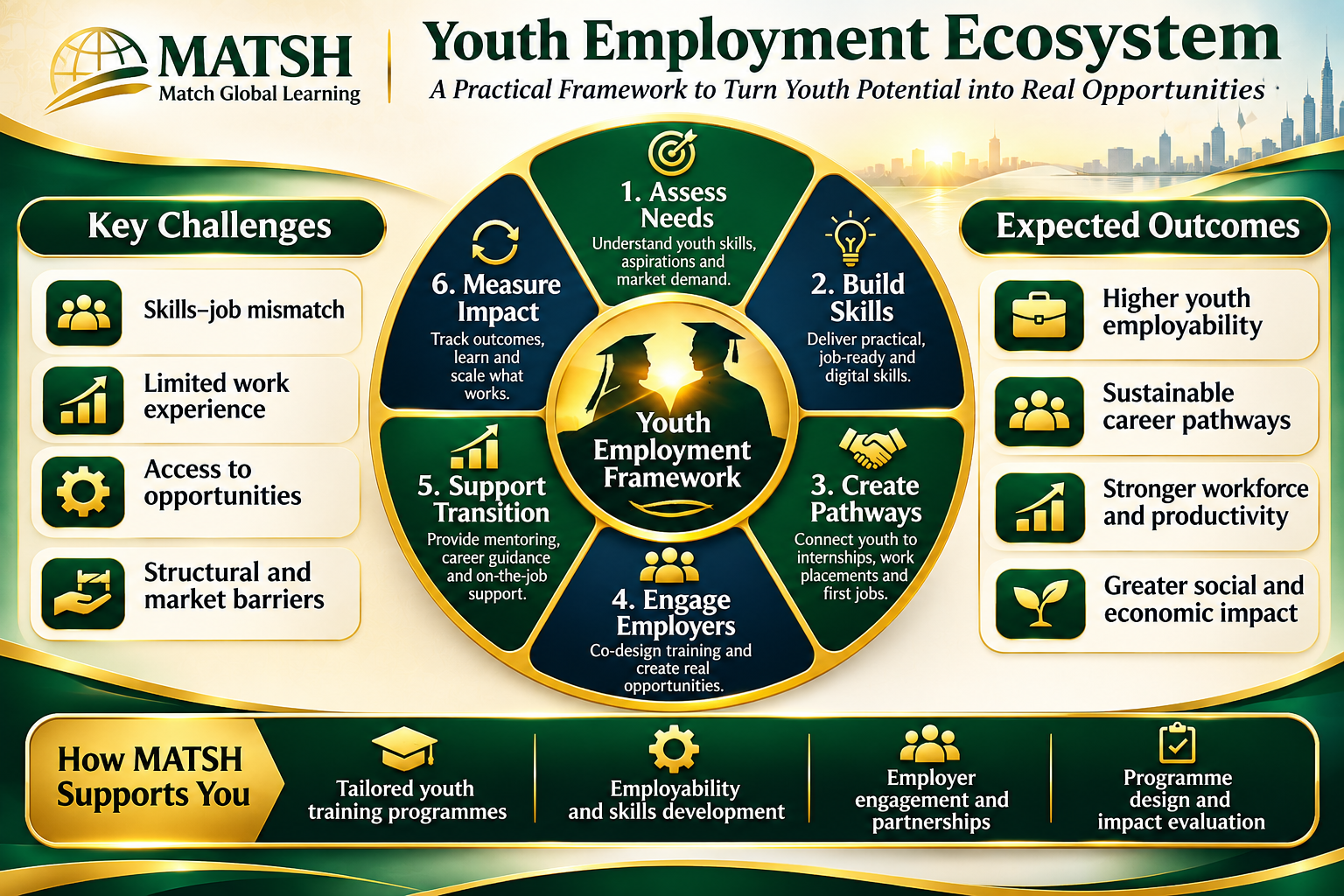
1. Define the labour-market problem precisely
| Problem | Possible mechanism |
|---|---|
| High youth unemployment | Weak labour demand, skills mismatch, hiring friction or access barriers |
| High vacancy + high unemployment | Matching, skills, location or information mismatch |
| Low earnings | Low productivity, poor job quality, informality or weak bargaining power |
| Short job tenure | Bad matching, weak workplace readiness or poor employment conditions |
2. Diagnose demand before designing supply
Demand evidence can include:
- Vacancies and hiring trends
- Employer interviews
- Sector growth / contraction
- Wage and turnover patterns
- Hard-to-fill roles
- Firm constraints
- Geographic opportunity
- Informal and self-employment markets
3. Segment young people by barriers, not just age
A 19-year-old school leaver in a city, a 24-year-old mother returning to work and a 28-year-old rural graduate may need different service packages even if they are all labelled “unemployed youth”.
Main barrier may be matching, information or networks.
Needs occupational or foundational capability.
Needs supervised work-based learning.
Transport, childcare, disability or documentation blocks participation.
May need market, capital and business support, not generic motivation training.
4. Identify binding constraints
A programme cannot afford to solve every problem. Identify which barriers are necessary to address for the target group to reach work.
Graduates complete digital-skills courses but remain unemployed
Employer interviews show technical skills are adequate. The bigger gaps are no work portfolio, no references and poor access to hiring networks.
The intervention shifts from more classroom training toward project-based work samples, employer projects, structured placement and job-search support.
5. Choose interventions by mechanism
| Barrier | Possible intervention |
|---|---|
| Occupational skill gap | Market-relevant training + assessment/certification |
| Search/matching gap | Employment services, counselling, vacancy matching |
| No experience | Internship, apprenticeship, work trial, employer project |
| Employer hiring risk | Time-limited subsidy or supported placement where appropriate |
| Self-employment opportunity | Entrepreneurship support linked to viable markets |
| Access constraint | Transport, childcare, accommodation, disability support |
6. Build integrated service packages selectively
The World Bank’s 2026 guidebook highlights comprehensive scope, but “comprehensive” should not mean every participant receives every service. Use segmentation and case management to vary intensity.
7. Involve employers before curriculum design
Ask employers:
- Which roles are genuinely hiring?
- Which tasks define entry-level competence?
- Which screening criteria are essential versus habitual?
- Which skills can be learned on the job?
- What makes new hires fail or leave?
- What supervision capacity exists?
8. Separate employer demand from employer wish lists
Employers may request long lists of desirable skills. Prioritise the capabilities that actually affect hiring and performance rather than turning every preference into curriculum.
9. Design work-based learning with learning objectives
| Weak internship | Stronger work-based learning |
|---|---|
| “Gain exposure” | Defined role/tasks and skill outcomes |
| No supervisor standard | Named supervisor with feedback expectations |
| Administrative errands | Progressive work tasks |
| No assessment | Work sample / supervisor evidence |
10. Protect against unpaid low-value placements
A placement that substitutes free labour for real learning can create activity counts without improving employability. Define minimum learning, supervision and safeguarding standards.
11. Design entrepreneurship support for market opportunity
Entrepreneurship should not be a fallback for every young person who cannot find wage employment. Assess participant preference, market demand, capital needs, competition and realistic business viability.
12. Integrate employment services
Real occupations, requirements and wages.
Applications, interviews and networking.
Connect participants with relevant vacancies.
Address barriers and adjust support intensity.
13. Connect social protection where barriers are economic
The World Bank’s 2026 framework includes integration with social protection among its five design principles. For very poor or vulnerable participants, training without transport, childcare or temporary income support may be inaccessible.
14. Build inclusion into programme operations
| Barrier | Design response |
|---|---|
| Young women restricted by care responsibilities | Schedule, childcare, safe transport, employer engagement |
| Disability | Accessible recruitment, venue/technology and employer accommodation |
| Rural distance | Local delivery, transport or remote options where viable |
| Low digital access | Device/connectivity support and offline alternatives |
15. Design provider incentives carefully
Paying providers only for enrolment can produce volume without outcomes. Paying only for employment can create “cream-skimming” where providers avoid harder-to-place youth.
Milestone-based payment
A contract might combine quality-assured completion, verified placement and retention milestones, with safeguards against excluding higher-barrier participants. The exact design depends on market and programme capacity.
16. Monitor delivery quality, not only attendance
Quality evidence
- Trainer/coach capability
- Practice and assessment quality
- Employer involvement
- Placement supervision
- Participant dropout reasons
- Safeguarding
- Employer feedback
17. Measure job quality
Placement counts can hide unstable or exploitative work. Where feasible, examine retention, earnings, hours, formality, safety, benefits and progression.
18. Track retention beyond placement day
| Point | Question |
|---|---|
| Placement | Did participant enter work? |
| 3 months | Is employment sustained? |
| 6–12 months | Is income/job quality improving? |
| Progression | Did the participant gain skills, responsibility or better work? |
19. Compare outcomes by participant segment
An average placement rate can hide strong outcomes for already job-ready participants and weak outcomes for vulnerable groups. Disaggregate before deciding the programme works.
20. Use cost per sustained outcome
Cost per enrolment is easy to calculate but can reward low-intensity programmes with little labour-market impact. Compare cost with sustained employment, earnings or other intended outcomes.
21. Adapt based on evidence
Diagnose
Which barrier is binding?
Design
Choose service package and employer role.
Deliver
Monitor quality and inclusion.
Measure
Placement, retention, earnings and job quality.
Redesign
Change weak components rather than repeating them.
22. Do not copy a successful programme without its context
The 2026 evidence base shows that programme effects vary by design and context. Adapt mechanisms, not branding.
Common youth-employment design mistakes
23. Map the employer hiring funnel
Labour demand is not just vacancy count. Understand where young candidates are screened out and why.
| Stage | Diagnostic question |
|---|---|
| Vacancy | Which entry-level roles genuinely recur? |
| Application | Are requirements proportionate to the job? |
| Screening | Which credentials or experience filters exclude youth? |
| Interview | Which behaviours/skills determine selection? |
| Offer | Do pay, location or hours cause rejection? |
| Retention | Why do young hires leave? |
24. Distinguish skill gaps from signalling gaps
A young person may have the capability but lack a credential, portfolio, reference or recognised signal that convinces employers. In that case, assessment, certification or work samples may create more value than additional training.
25. Use employer commitments, not only employer consultations
Stronger employer participation can include:
- Validate task standards
- Provide real work examples
- Offer supervisors for work-based learning
- Commit interview slots
- Provide hiring feedback
- Share retention reasons
26. Design case-management intensity
| Participant need | Possible support intensity |
|---|---|
| Job-ready | Vacancy matching and light coaching |
| Moderate barriers | Training + job search + targeted support |
| Multiple barriers | Case management, referral, access support and longer follow-up |
27. Set referral rules for needs outside programme scope
Employment programmes may uncover mental-health, housing, safeguarding, legal or health issues they are not equipped to address. Build referral partners and clear boundaries rather than asking employment coaches to solve everything.
28. Define work-based learning quality gates
Real tasks linked to occupational capability.
Named person responsible for feedback.
Specific outcomes and progression.
Appropriate safeguarding and workplace conditions.
Work sample or supervisor assessment.
29. Use employer feedback to redesign curriculum
Track patterns in rejected candidates and early leavers. If employers repeatedly identify the same capability gap, test whether the curriculum or assessment needs to change.
30. Plan for provider market capacity
A sophisticated service model is not useful if local providers cannot deliver it reliably. Assess trainer quality, employer networks, case-management capacity, data systems and geographic coverage before finalising design.
31. Avoid payment incentives that distort behaviour
Provider paid only for placement
The provider begins rejecting participants with disability, childcare constraints and long unemployment spells because they threaten the outcome rate.
A stronger contract can combine inclusion rules, quality milestones and weighted sustained outcomes so performance incentives do not undermine targeting.
32. Build safeguarding into youth-employment delivery
Work placements, transport, recruitment and employer contact can create safeguarding risks. Define screening, reporting, supervision and escalation appropriate to participant age and context.
33. Pilot the service package before large-scale rollout
Pilot questions
- Do participants use the intended services?
- Do employers honour their commitments?
- Which barriers remain unresolved?
- Where do participants drop out?
- Which provider processes fail?
- What does the pilot cost per sustained outcome?
34. Scale the mechanism, not the exact operating model
A pilot may depend on unusually strong staff, employers or local labour demand. Before scaling, identify which elements are essential and which must adapt by region.
Design around the barrier between youth and real work
MATSH’s Youth Employability Programme Design Course covers labour-market diagnosis, participant segmentation, integrated services, employer partnerships, work-based learning, inclusion, provider incentives and outcome measurement.
Explore Youth Development
Explore the Youth Employability course
Register
Development-sector team training
NGO and programme teams can review MATSH’s development-sector training pathways and identify the responsibilities, donor requirements and field conditions that a staff cohort needs to address. For several colleagues, compare scheduled group places with private organisational training; confirm delivery scope, participant levels, dates and fees before making plans.
Sources
Need In-House Training?
We run all our courses as private programmes for organisations across the GCC and Africa.
Request In-House →