Environmental Education in Youth Programs: An Evidence-Based Design Guide
March 14, 2025 · Education · 8 min read
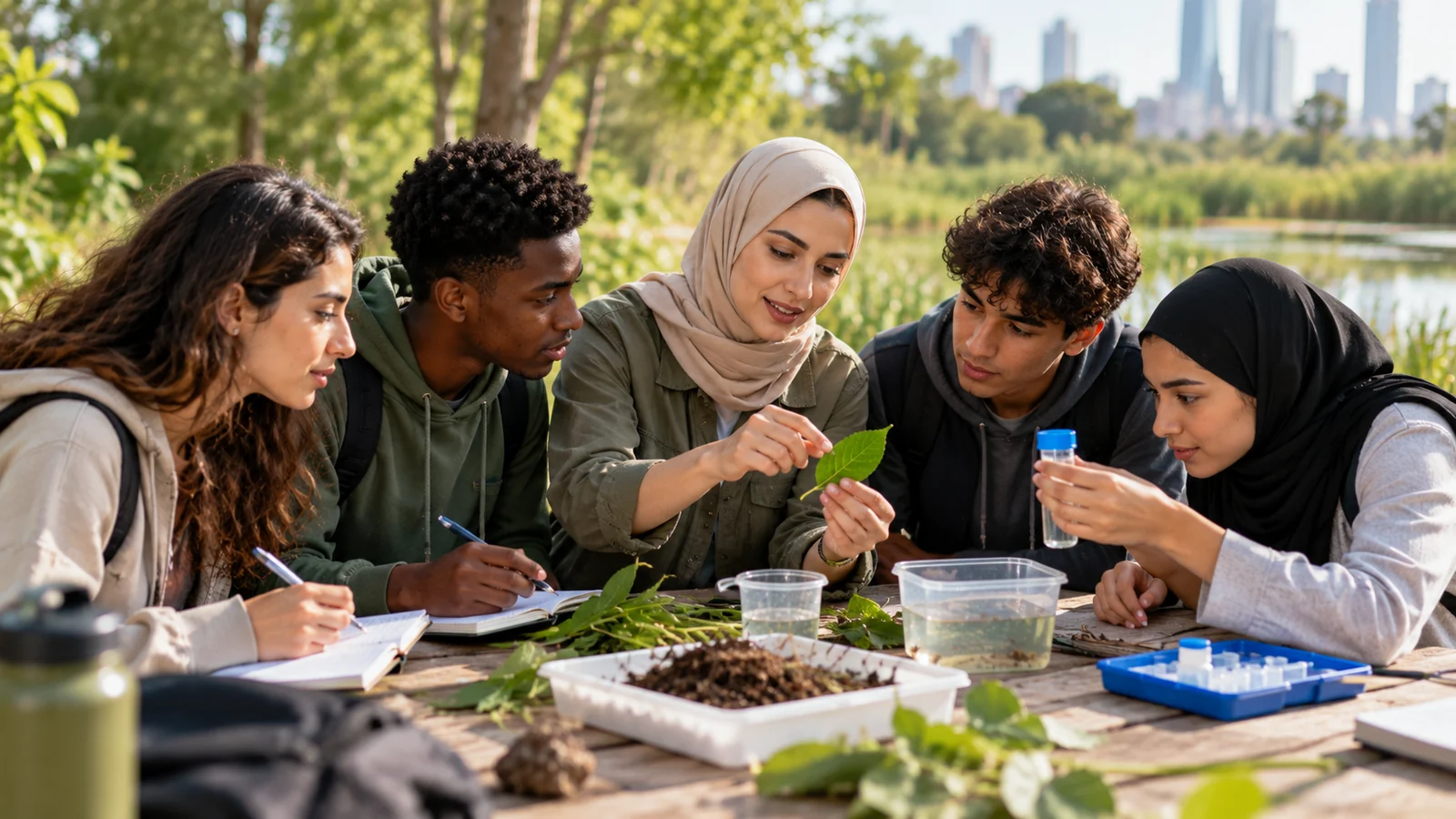
Environmental education for young people works best when it combines accurate knowledge with local investigation, reflection and meaningful action. It should help learners understand environmental systems, examine evidence, make informed decisions and see how their choices connect to communities and ecosystems.
UNESCO’s Greening Curriculum Guidance recommends a holistic, scientifically accurate, justice-aware and action-oriented approach to climate and sustainability education. It also emphasises learner-centred, experiential, reflective and collaborative learning rather than relying only on information delivery.
Source: UNESCO, Greening Curriculum Guidance, 2024
Start with the learning outcome, not the environmental activity
A tree-planting day, clean-up or recycling campaign can be useful, but an activity is not automatically an educational programme.
Define what participants should learn or be able to do. Outcomes can include:
- understanding a local environmental system;
- interpreting environmental data;
- distinguishing evidence from claims;
- analysing trade-offs;
- working collaboratively on a local problem;
- communicating findings;
- planning a realistic environmental action;
- reflecting on personal and collective responsibility.
Use local environmental questions
Environmental issues become more concrete when young people can investigate something they can see or experience.
Depending on location, projects might examine:
- water quality or access;
- waste and recycling;
- urban heat;
- air quality;
- biodiversity;
- food systems;
- coastal change;
- energy use;
- flooding;
- soil quality;
- transport and emissions.
Local relevance does not mean ignoring global science. It gives learners a context in which to apply it.
Teach climate and sustainability as more than a science topic
UNESCO’s guidance treats climate education as interdisciplinary. Environmental questions can involve:
- science and ecology;
- mathematics and data;
- economics;
- health;
- technology;
- geography;
- civics;
- ethics;
- communication;
- culture and local knowledge.
This helps young people see that environmental decisions involve systems and trade-offs, not isolated facts.
Build scientific accuracy into programme design
Environmental topics are vulnerable to misinformation and oversimplification.
Programme designers should:
- use credible scientific and official sources;
- separate established evidence from uncertainty;
- date statistics;
- avoid dramatic claims without a traceable source;
- teach learners how to inspect evidence;
- update material when scientific understanding or policy changes.
For climate topics, useful sources include IPCC, national environmental authorities, meteorological services, UNEP and UNESCO.
Experiential learning should include reflection
Hands-on activity is valuable when learners connect the experience to concepts and reflect on what happened.
A simple cycle can be:
- Experience: investigate, observe, collect data or participate in an activity.
- Reflect: what did we notice and what surprised us?
- Explain: which concepts or evidence help us understand it?
- Apply: what should we test, change or investigate next?
This avoids treating “being outdoors” as sufficient evidence of learning.
Use environmental data carefully
Youth programmes can build data literacy through real environmental information.
Participants might:
- record temperatures in different locations;
- categorise waste;
- map tree cover;
- measure water indicators with appropriate equipment;
- analyse public air-quality data;
- compare energy use over time.
Teach the limitations of the data as well as the results. Sample size, measurement error and uncontrolled variables matter.
Community projects should solve a real problem, not create symbolic activity
Before launching an action project, ask:
- Who is affected?
- Who already works on this issue?
- What action is realistically within the programme’s control?
- What permission is required?
- Could the action create unintended harm?
- How will success be measured?
A small, well-designed project can be more educational than a large campaign with no clear outcome.
Partner with local expertise
Environmental education can become stronger through partnerships with:
- schools and universities;
- environmental agencies;
- municipal services;
- conservation organisations;
- community groups;
- farmers and local producers;
- water or energy utilities;
- scientists and technical professionals.
Partners can provide real problems, data, technical guidance and routes for youth findings to reach decision-makers.
Young people should have real voice in programme design
UNESCO’s greening-curriculum work responds directly to youth demand for climate education that supports meaningful action.
Young participants can help:
- select local issues;
- design research questions;
- choose communication formats;
- lead project teams;
- present findings;
- evaluate the programme.
Youth voice should be meaningful while adults retain safeguarding, legal and technical responsibilities.
Environmental education should not produce fear without agency
Climate and environmental issues can feel overwhelming. Programmes should be honest about risk without using fear as the primary teaching method.
A balanced approach helps participants understand:
- the scale of the issue;
- what is uncertain;
- which actions are individual;
- which actions require organisations or public systems;
- what young people can realistically influence.
Include justice and different levels of responsibility
Environmental impacts and the resources available to respond are not distributed equally.
UNESCO’s guidance encourages climate education to include questions of justice. Depending on age and context, learners can examine:
- who experiences environmental harm;
- who benefits from a particular activity;
- who has decision-making power;
- how costs and benefits are distributed;
- how proposed solutions affect different groups.
Adapt learning to age and developmental stage
A primary-school activity, a secondary youth programme and a professional youth-leadership programme should not use the same depth or responsibility.
UNESCO provides expected climate-learning outcomes across age groups from age five through adult learning.
For younger participants, focus more on observation, systems, care and concrete local action. Older youth can engage with data, policy, trade-offs, technology and project design in greater depth.
Integrate STEM without turning every project into a technology project
Environmental issues provide authentic contexts for science, mathematics and technology, but technology should be used because it helps answer a question.
Examples include:
- spreadsheets for analysing field data;
- mapping tools;
- simple sensors;
- data visualisation;
- coding for environmental datasets;
- GIS where appropriate.
Low-cost observation and manual data collection can still support excellent learning.
Safeguarding applies to field activities
Environmental programmes can involve travel, water, tools, heat, roads, wildlife or unfamiliar locations.
Risk assessment should cover:
- supervision;
- transport;
- weather;
- equipment;
- water safety;
- first aid;
- accessibility;
- consent;
- emergency procedures.
Make programmes accessible
Outdoor or field-based learning should not automatically exclude young people with disabilities or health needs.
Consider:
- accessible sites;
- alternative ways to collect or analyse data;
- transport;
- sensory needs;
- digital alternatives where appropriate;
- clear information about physical demands.
Use the whole learning environment
UNESCO’s Green School Quality Standard identifies four connected areas:
- governance;
- facilities and operations;
- teaching and learning;
- community engagement.
Source: UNESCO, Green School Quality Standard, 2024
This whole-institution approach can also inform youth organisations. It is difficult to teach waste reduction while the programme itself has no waste-management practice, for example.
Measure learning, not just attendance
Useful evaluation can examine:
- knowledge before and after;
- ability to interpret evidence;
- quality of project work;
- collaboration or leadership behaviours;
- participant reflection;
- completion of real environmental actions;
- community partner feedback.
Do not claim that participation caused long-term environmental behaviour without an evaluation design capable of supporting that conclusion.
Connect environmental learning to a visible decision cycle
Environmental education becomes more meaningful when participants can see how evidence leads to a choice and how that choice changes the local environment. Activities should therefore be designed as a learning cycle rather than a one-off event.
For a heat, waste, water or biodiversity project, participants can first observe a local condition, collect proportionate evidence, compare possible explanations, choose an action they can realistically influence and then review what happened. The reflection stage matters because it helps young people distinguish a meaningful intervention from symbolic activity.
This cycle also creates better evaluation. Facilitators can assess whether participants improved their ability to ask questions, use evidence, work with others, explain a decision and adapt after seeing results. Those outcomes are more educationally useful than counting attendance or the number of items collected during a one-day campaign.
A practical programme sequence
- Select a local issue.
- Define age-appropriate learning outcomes.
- Identify credible sources and local experts.
- Design an investigation or practical experience.
- Build in reflection and discussion.
- Let young people propose possible actions.
- Assess feasibility, safety and unintended effects.
- Implement a realistic project.
- Measure learning and project results separately.
- Share findings with a relevant audience.
Example: neighbourhood heat project
A youth group could investigate heat differences around its neighbourhood.
The programme might:
- teach basic concepts about heat, surfaces and shade;
- measure temperatures at selected locations;
- map trees and shade;
- analyse patterns;
- interview local residents;
- research realistic cooling interventions;
- present recommendations to a school or community organisation.
The value comes from integrating scientific understanding, data, community perspective and action.
Example: waste audit
Participants can conduct a structured waste audit in a school or youth centre, identify major waste streams, research alternatives and test one intervention.
Measure the waste stream before and after rather than reporting only how many people joined the campaign.
Connect environmental education with positive youth development
Well-designed environmental projects can also create opportunities for youth voice, teamwork, problem solving and community contribution.
These outcomes should still be measured carefully rather than assumed. See MATSH’s Youth Development Programs evidence guide for the wider positive-youth-development framework.
Frequently asked questions
Does environmental education improve academic performance?
Research on environmental and nature-based education includes promising findings, but effects vary by programme, population and outcome. Avoid universal percentage claims. Design the programme around clear learning objectives and measure the outcomes directly.
Does environmental education need to happen outdoors?
No. Outdoor and field experiences can be valuable, but environmental learning can also use public data, simulations, local case studies, indoor experiments and community research.
What makes climate education high quality?
UNESCO recommends scientifically accurate, holistic, locally relevant, action-oriented and age-appropriate learning that includes cognitive, social-emotional and action dimensions.
Should youth programmes promote environmental activism?
Programmes can support informed participation and community action, but educators should help young people examine evidence, perspectives, trade-offs and lawful routes for participation rather than prescribing a single political position.
How should environmental projects be evaluated?
Measure learning and project outcomes separately. Attendance, knowledge gain, quality of analysis, participant skills and a project’s environmental result are different measures.
Sources
Need In-House Training?
We run all our courses as private programmes for organisations across the GCC and Africa.
Request In-House →