Creativity and Innovation at Work: From Problem Framing to Tested Ideas
October 2, 2026 · Professional Development · 7 min read
Creativity creates options. Innovation turns a selected option into something people actually use.
That distinction matters because organisations can generate hundreds of ideas without producing one meaningful innovation. A productive innovation process starts with a well-framed problem, generates genuinely different options, selects ideas against explicit criteria, tests the most important assumptions cheaply and then turns evidence into an implementation decision.
The OECD’s Oslo Manual defines a business innovation as a new or improved product or business process that differs significantly from the firm’s previous products or processes and has been introduced on the market or brought into use. That final requirement matters: implementation separates an innovation from an idea that never leaves the workshop.
Source: OECD/Eurostat, Oslo Manual 2018
The World Economic Forum’s Future of Jobs Report 2025 also places creative thinking among the skills employers expect to rise in importance through 2030, alongside resilience, curiosity and lifelong learning.
Source: World Economic Forum, Skills outlook
A practical innovation pipeline
1. Frame the problem before generating solutions
A weak problem statement often smuggles the preferred solution into the question. “How can we automate approvals?” assumes automation is the answer. “How can we reduce the time from completed request to approved decision without weakening control?” creates a wider solution space.
| Weak framing | Better framing | Why it is better |
|---|---|---|
| How do we build a new app? | How can customers complete this task with less time and fewer errors? | Allows process, service and technology options |
| How do we make staff attend training? | How can employees reliably perform the target behaviour? | Focuses on performance rather than attendance |
| How do we cut meeting time? | How can the team make the required decisions with less coordination cost? | Allows changes to cadence, roles, information and channels |
| How do we copy the competitor? | What customer need is the competitor addressing, and what other ways could we meet it? | Moves from imitation to underlying value |
2. Separate divergent thinking from judgement
Idea generation needs enough psychological room for unusual options to appear. Evaluation needs discipline. Mixing the two too early usually produces safe variations of the current approach because participants begin editing themselves before the option set is broad enough.
Generate alternatives, analogies, inversions, extreme versions and deliberately different routes.
Silent individual generation can reduce the advantage of the quickest or most senior speakers.
Do not force every early idea to survive budget, policy and implementation objections immediately.
Switch modes later and evaluate against agreed criteria rather than enthusiasm alone.
3. Use explicit criteria to select ideas
Innovation decisions become political when criteria appear only after people have become attached to particular ideas. Define the decision dimensions first.
| Criterion | Question |
|---|---|
| Customer/user value | Would this materially improve an important outcome for the intended user? |
| Strategic fit | Does it support what the organisation is actually trying to achieve? |
| Feasibility | Can we build, operate and support it with realistic capability and resources? |
| Evidence | What do we know versus what are we assuming? |
| Risk | What could create legal, safety, financial, reputational or operational exposure? |
| Learning value | Can a small test resolve a major uncertainty cheaply? |
4. Test the assumption most likely to kill the idea
Teams often prototype the easiest part of an idea instead of the riskiest assumption. A better test asks: “What must be true for this idea to work, and which uncertain assumption would make the idea fail if it is wrong?”
Idea: replace a long customer onboarding form with an AI-assisted conversational flow
The team could spend months building the full experience. Instead, it identifies the most dangerous assumptions first: customers will trust the interaction, the system can collect required information accurately, and compliance reviewers will accept the resulting audit trail.
The first test therefore does not need a full product. The team can prototype the conversation manually, test whether users understand the questions, compare data completeness with the current form and involve compliance before engineering begins.
If the critical assumptions fail, the organisation has learned cheaply. If they hold, the next test can be larger.
5. Treat failed experiments as information, not automatic project failure
Innovation requires some ideas to be stopped. The important distinction is between an inexpensive experiment that disproves an assumption and a large untested implementation that fails after significant investment.
A controlled test reveals early that customers will not adopt the proposed feature.
The organisation scales the feature without testing adoption and learns the same lesson after a major launch.
The evidence shows a core assumption is wrong and the team closes the idea.
More money is committed mainly because the organisation has already spent money.
6. Innovation includes process improvement, not only new products
The OECD definition covers both product innovation and business process innovation. That means meaningful improvements to logistics, HR, service delivery, finance, administration, sales, IT or management processes can count as innovation when the process differs significantly from what the firm previously used and is actually implemented.
This is useful because many teams assume innovation belongs to a product lab. In reality, operational innovation can remove friction, improve reliability, strengthen resilience or make services easier to use.
7. Build an innovation portfolio instead of betting everything on one idea
| Type | Typical uncertainty | Management approach |
|---|---|---|
| Incremental improvement | Low | Fast decisions, short tests, operational ownership |
| Adjacent innovation | Moderate | More customer discovery, cross-functional testing |
| Transformational bet | High | Stage funding, explicit assumptions, senior sponsorship and stronger risk review |
A healthy portfolio prevents two extremes: only making tiny safe improvements, or treating every innovation as a dramatic transformation project.
8. Design innovation sessions so hierarchy does not decide the answer
In many workplaces, participants read the room before they share an idea. If the most senior person speaks first, the remaining discussion can become a refinement of that view.
Facilitation rules that improve option quality
- Start with individual written thinking before open discussion.
- Ask participants to generate multiple options before choosing one.
- Rotate who presents first.
- Separate idea generation from evaluation.
- Use explicit selection criteria.
- Invite the person closest to the customer or process to contribute before senior sponsors close the discussion.
- Record assumptions alongside ideas so later testing is easier.
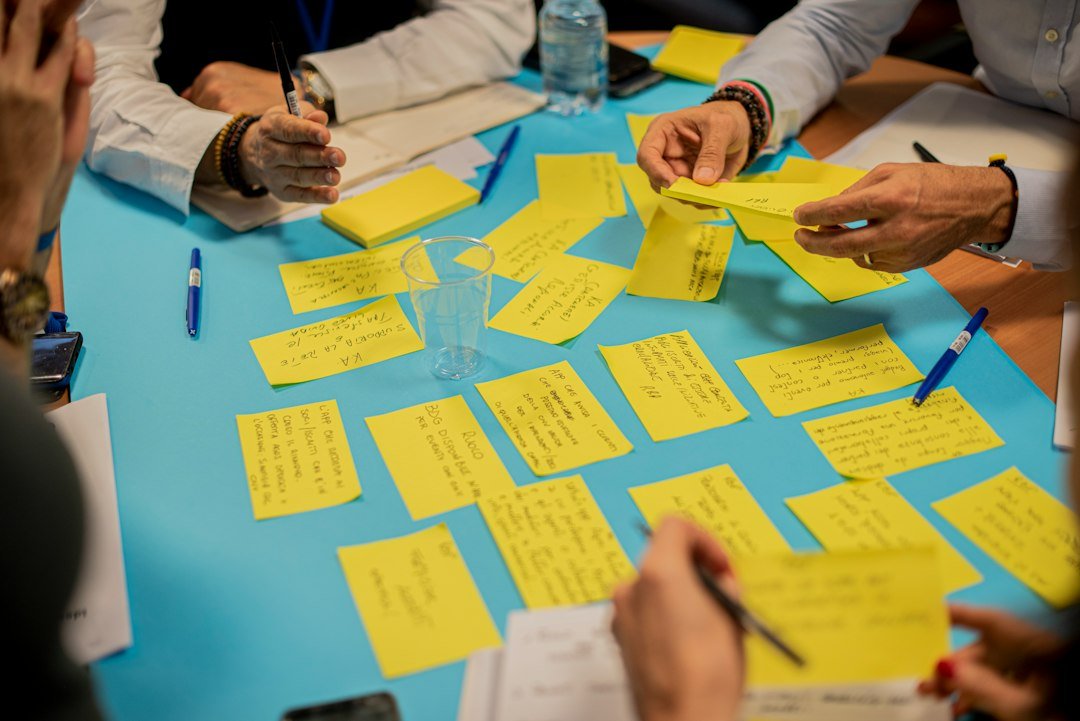
- End with an owner and next experiment, not only a photograph of sticky notes.
Common reasons innovation initiatives stall
A simple innovation dashboard
| Measure | What it tells you | Caution |
|---|---|---|
| Problems/opportunities entering pipeline | Whether the organisation is surfacing useful challenges | Volume alone is not value |
| Ideas tested | Whether concepts move beyond discussion | A bad test can create false confidence |
| Time to first meaningful test | How quickly teams reduce uncertainty | Not every complex idea should be rushed |
| Ideas stopped after evidence | Whether teams can kill weak options early | A high number is not automatically good or bad |
| Implemented innovations | Whether the pipeline reaches use | Implementation is not proof of impact |
| Outcome measure | Whether the innovation changed the intended customer or business result | Choose the metric before scaling |
A 90-minute innovation session should end with an experiment, not an idea list
| Time | Activity | Output |
|---|---|---|
| 0–15 min | Clarify the problem, user and desired outcome | One agreed problem statement |
| 15–30 min | Individual divergence before group discussion | Broad option set without early anchoring |
| 30–45 min | Combine, challenge and extend ideas | Distinct concepts rather than duplicates |
| 45–60 min | Score against value, feasibility, risk and learning value | Shortlist with visible rationale |
| 60–75 min | Identify the riskiest assumption in each finalist | Testable hypotheses |
| 75–90 min | Design the smallest useful experiment and assign an owner | Next action, evidence target and decision date |
This structure prevents the common failure where the workshop produces attractive ideas but no commitment. The true deliverable is not the wall of notes. It is a decision about what the organisation needs to learn next and who owns that learning.
Move from ideas to implemented change
MATSH’s Creativity and Innovation Training Course develops problem framing, structured ideation, inclusive facilitation, idea selection, experimentation and implementation around real organisational challenges.
Sources
Need In-House Training?
We run all our courses as private programmes for organisations across the GCC and Africa.
Request In-House →