
Did you know Seychelles, an island nation in the Indian Ocean, is the top African country for education? It scores 69.3 points1. This shows how many African nations are improving their education. The World Education Forum’s report on 140 countries, including 38 African ones, helps us find the top 10 countries for education1.
The report looks at how well countries prepare their workforce. It checks the quality and amount of education, including digital skills and creativity. These rankings are great for finding the best places in Africa for studying abroad1.
Key Takeaways
- Africa has many different educational systems. Several countries are now top choices for higher education.
- The World Education Forum’s report shows the quality and amount of education in African countries. It highlights the region’s academic strengths.
- Seychelles, Tunisia, and Mauritius are among the top African nations for education.
- South Africa, Algeria, and Botswana also have strong higher education systems in the continent.
- The report is useful for international students and those looking for quality education in Africa.
Introduction to Higher Education in Africa
Education is key for progress and growth in Africa. With over 70% of the population under 302, it’s vital to meet the educational needs of young people. This is important for economic growth and better living standards. Yet, higher education in Africa faces big challenges.
Admission rates are almost 80% lower than the global average of 42%2. Universities also face severe funding issues. They get only 0.3% of GDP for research and development, much less than North America and Europe’s 2.25%3.
Despite these hurdles, some African countries are working hard to improve their higher education. Seychelles, Tunisia, Mauritius, and South Africa are leading the way. They focus on quality education, research, and working with other countries2.
As these countries invest in education, Africa is becoming a top choice for students from around the world. More and more international students are coming to African universities2.
The path to academic excellence in Africa2 is complex. It needs a complete approach to solve the challenges of African education. By working together, using technology, and finding new solutions3, Africa can reach its full potential. This will make it a top place for learning globally2.
Seychelles: Africa’s Educational Powerhouse
Seychelles is a top example of education in Africa. It has a population of 120,581, with most living on Mahé4. The country’s high GDP per capita of $15.8 billion in 20224 helps fund its education.
Seychelles’ Remarkable Education Achievements
Seychelles’ education system is top-notch. It has fully accomplished UNESCO’s “education for all” goal and a 95.87% literacy rate. Education is free until 18, making quality education accessible to all4.
Factors Contributing to Seychelles’ Success
Several factors have made Seychelles’ education great. A strong focus on education, teacher training, and digital skills are key4. Also, strong economic growth and tech investment boost education.
Seychelles is known as Africa’s educational powerhouse. It focuses on quality education, digital skills, and critical thinking. This sets a high standard for Africa4.
Tunisia’s Impressive Educational System
Tunisia’s education system is known for its quality, ranking 71st globally with a 61.4% excellence rate5. The government invests 20% of its budget in education5. This has helped Tunisia rank 49th for school life expectancy and 51st for the pupil-to-teacher ratio5.
Education in Tunisia is free and compulsory until secondary school5. This has led to high literacy rates, especially among the young5. For example, 96.1% of 15-24-year-olds can read and write5.
Despite progress, Tunisia still faces challenges like high unemployment, especially among women and graduates5. Yet, the government is committed to education reform and investment5. The World Bank predicts Tunisia’s economy will grow by 4% next year, helping fund better education5.
| Metric | Value |
|---|---|
| Population | 11.5 million |
| Education Spending (% of GDP) | 6.2% |
| Enrollment in Kouttabs (1987-2007) | Increased from 278 to 961 |
| Literacy Rate (15-24 years old) | 96.1% |
| Education Rate (2007) | 96.7% for girls, 95.5% for boys |
| Unemployment Rate | 15.5% overall, 22.8% for women, 29.4% for graduates |
| Economic Growth Projection | 4% in the next year |
Tunisia’s education has made great strides, but it still faces unemployment challenges5. The government’s big investment in education and the expected 4% economic growth suggest a bright future5.
Tunisia may not be as top-ranked as the United States in education6. But, its steady progress and education investments show promise5. As Tunisia updates its media and culture6, it can use its strong education to attract talent and lead in higher education6.
Mauritius: A Rising Star in African Education
Mauritius is a top example of education in Africa7. It grew its GDP per capita by 5.4% from 1970 to 2010. This is much higher than Africa’s 1% growth during the same time7.
By 2010, Mauritius had a per capita income of about $7,000. Its purchasing power parity (PPP) was $11,0007. The country’s economic growth is linked to its education investment.
Mauritius’ Vocational Training Prowess
Mauritius is ranked 47th in the world for vocational training7. The government makes education free and accessible to all. It also focuses on vocational programs for the workforce8.
These efforts have made Mauritius the 3rd best education system in Africa7. It ranks 74th globally in education7.
The government’s focus on education has paid off. Mauritius is first in sub-Saharan Africa in the Rule of Law index7. In 2007, it was ranked 2nd in the UN Human Development Ranking7.
Mauritius’ success is due to its strategic investment in education7. This focus on quality education and vocational training has helped its economic and social growth.
Mauritius’ education achievements show the power of investing in human capital7. As it continues to lead in African education, it inspires other nations.
Learn more about Mauritius’ youth leadership program at this link.
South Africa: A Beacon of Academic Excellence
South Africa is proud of its strong higher education system. It stands out as a beacon of academic excellence in Africa. It has many top universities, ranking high in Africa9.
Top South African Universities
The University of Cape Town (UCT) leads the list of top universities in Africa. Founded in 1874, UCT has a 50% acceptance rate. It has published 74,551 papers and gotten 1,738,499 citations10.
Other top universities in South Africa are Stellenbosch University, University of Witwatersrand, and University of KwaZulu-Natal. They are all in the top 10 in Africa9.
The government of South Africa is investing more in education. This shows its commitment to improving the education system. Education now gets about 18% of the country’s budget9.
The University of South Africa (UNISA) is a leader in distance learning. It offers innovative online programs and uses cutting-edge technologies. UNISA also focuses on building a sense of community among its students11.
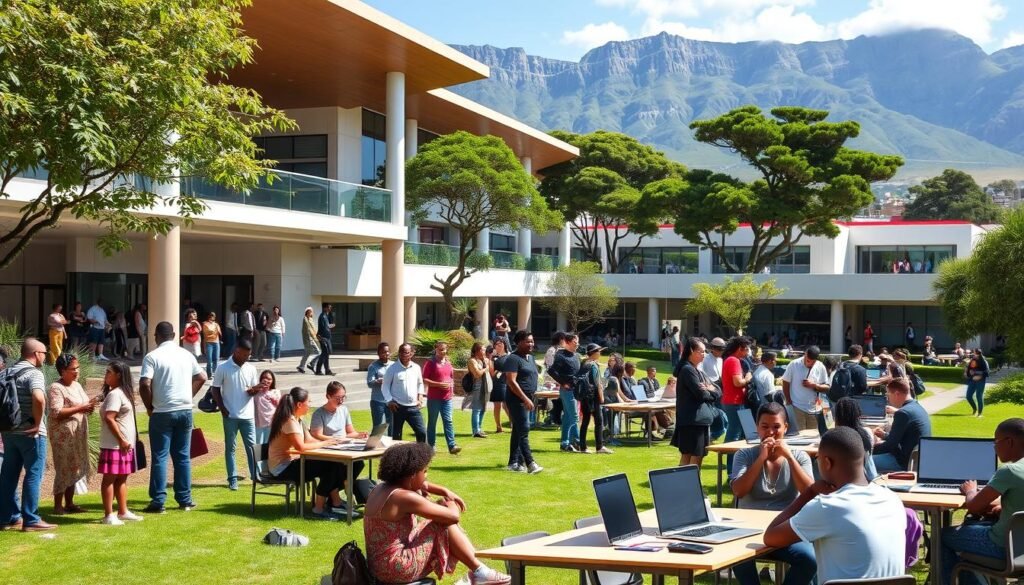
South Africa’s success in education shows its dedication to quality, literacy, and innovation. As it keeps investing in higher education, it remains a beacon of academic excellence in Africa9.
Algeria: North Africa’s Educational Hub
Algeria is the second-best country in North Africa for education. It ranks12 5th in Africa with 57.4 points. The government makes education free and compulsory for kids aged 6 to 1512.
This effort has led to a literacy rate of 75% in Algeria12. The algeria education system, algeria education compulsory, and algeria education free are key to this success.
Algeria has many top universities, like the University of Sciences and Technology Houari Boumediene. These schools are among the best in Africa12. The country’s focus on algeria education quality and algeria education investment has made it a major algeria education hub in North Africa12.
Algeria’s education reforms have greatly improved algeria education literacy. They have also created a skilled workforce. This workforce helps the country grow economically and socially12.
Algeria keeps education as a top priority. It is a shining example of academic excellence in the region. It offers great opportunities for both local and international students12.
Botswana: Fostering Lifelong Learning
Botswana is a top example in Africa’s education scene. It has an 88% literacy rate among 2.3 million people13. The country makes sure everyone learns from age 4 to 18, offering quality education14.
Botswana works hard to improve its teachers and keep students in school. It’s ranked the 92nd best country for higher education globally, and 6th in Africa14. Adult learners over 25 are also learning, thanks to the country’s education investment14.
Botswana’s adult learning programs boost literacy and help people grow professionally14. The Adult Basic Education Programme (ABEP) gives adults skills like reading and math, plus job training13.
| Key Achievements | Figures |
|---|---|
| Youth literacy rate | 94%13 |
| Adult literacy rate | 83%13 |
| Enrolment in National Literacy Programme (NLP) | 38,660 participants in 1985 to 11,771 in 200113 |
| Rural illiteracy rate | 34.5% compared to 14.6% in urban areas13 |
Botswana uses Andragogy to teach adults well14. This approach includes hands-on learning and letting students take charge. It helps adult learners grow and improve their skills14.
Botswana keeps focusing on education and lifelong learning. It’s a leader in Africa, showing others how to create a culture of ongoing learning13.
Top Countries for Higher Education in Africa
Many African countries are improving their higher education systems15. Nigeria, Ghana, Zimbabwe, Rwanda, and Malawi are working hard to offer better education16. They have universities and research centers that attract students from all over15.
These countries are focusing on education and human development15. This means more African countries will become top places for studying15.
The best universities in Africa focus on change, diversity, and innovation15. In South Africa, the University of Cape Town and others offer great programs15. The top 10 universities in Sub-Saharan Africa include schools from South Africa and Nigeria15.
Africa’s young population is both a challenge and an opportunity for education16. With a median age of 19 and a big share of the world’s workforce by 2050, Africa is set to play a big role in the global economy16. African countries need to invest in education and address issues of access and fairness.
As more people want to study in Africa, more countries will become top places for learning16. African students are choosing to study in places like France and the United States, showing the quality of African schools16. African universities can improve by working together, using technology, and being creative1516.
Kenya: Nurturing Intellectual Growth
Kenya is a top educational spot in Africa, ranking 7th with a score of 55.4 points. It’s also the 95th best globally for education17. The country has a high literacy rate of 78.7% and spends 17.58% of its budget on education17.
Kenya’s Investment in Education
The Kenyan government really cares about education, spending a lot on it17. It has a well-organized education system. This includes two years of pre-primary, six years of primary, and six years of secondary17.
Kenya is working hard to make education better. It’s part of a big effort to help kids read better by 202317. Also, making schools free for poor kids has helped more kids go to school17.
Kenya’s higher education is also strong. It has many top universities like the University of Nairobi and Kenyatta University17. These schools help make Kenya a center for learning in Africa.
But, Kenya faces some big challenges in education. Over 1.57 million kids in dry areas might not go to school because of drought17. Kenya needs to keep working on education to grow and succeed.
Cape Verde: An Island of Educational Opportunity
Cape Verde is a small island nation in the Atlantic Ocean. It has become a leader in education in Africa18. The country ranks 98th globally and 8th in Africa, with a score of 53.3 points18. This shows the government’s strong commitment to free and compulsory education.
Children in Cape Verde get free schooling from age 6 to 1418. This makes sure every child can learn well. The government has invested a lot in schools, teachers, and learning materials.
The country’s universities are also doing well18. Cape Verde’s universities are getting better in rankings. This means more chances for young people to get higher education and skills.
Cape Verde is also good at vocational training and lifelong learning18. The government helped small businesses, with 46% led by women18. This helps people learn new skills for the modern job market.
The country also focuses on helping everyone, not just some18. Over 150,000 people, mostly women, have benefited from programs18. This shows Cape Verde’s effort to include everyone in education and work.
Despite challenges, Cape Verde is making progress in education1819. Its focus on people’s skills and knowledge makes it a beacon of hope in Africa20.
| Indicator | Value |
|---|---|
| Country Classification | Lower middle-income |
| Land Area | 4,033 km² |
| Population (2019) | 0.55 million |
| Population Projection (2043) | 0.67 million |
| Youth Population (14-24 years) | 37.4% |
| Youth Unemployment (2014) | 50.8% |
Egypt: A Rich Legacy of Scholarly Pursuits
Egypt has a top-notch education system, ranking 9th in Africa and 99th worldwide for quality21. It boasts a literacy rate of 73.1%, showing its dedication to learning and growth21.
Universities like Cairo and Alexandria are known for their excellence. They have helped shape many leaders and innovators. This has made Egypt’s educational history rich and influential.
Digital Skills Development in Egypt
Egypt is working hard to improve digital skills in its students. It ranks 70th globally in digital skills, thanks to the government’s efforts21.
The country is focusing on giving students the digital tools they need. This is part of Egypt’s plan to become a center of innovation and technology.
Egypt is ready to make a big impact in the global knowledge economy. It aims to keep its status as a leader in education. The growth of education in Africa is linked to the continent’s population and economic growth. This could lead to new investment chances in different areas.
Namibia: Prioritizing Critical Thinking
Namibia is the 10th top country for higher education in Africa22. It has a population of 2,113,077 and covers about 823,000 km222. Since gaining independence, Namibia has focused on teaching critical thinking skills.
Namibia is a leader in critical thinking, ranking 52.7% and 88.2% in this area22. It also excels in training its educational staff, ranking 82nd and 43rd globally22.
Namibia is not as famous as some top African education countries. But, it stands out by teaching students to think critically and creatively22. This education prepares the next generation of leaders to face challenges and drive progress.
Despite its strengths, Namibia faces challenges in education23. It lacks data on student enrollment, attendance, and learning outcomes23. Also, there’s not enough information on teacher quality and education funding23.
To overcome these issues, Namibia needs to improve its data management23. Regular assessments and better data use will help improve education23.
Namibia’s focus on critical thinking makes it a rising star in African education22. By fixing data gaps and using its strengths, Namibia can improve its education system22.
Challenges Facing African Higher Education
African countries have made progress in their higher education. Yet, they still face big challenges. One major issue is the lack of funding and resources for higher education. They spend only 0.3% of their GDP on research and development, much less than the world average24.
Funding and Resource Constraints
The lack of resources has put a strain on institutions. It’s hard to meet the growing demand for higher education24. Also, getting into higher education is much harder than globally, with rates nearly 80% lower24.
Accessibility and Equity Issues
Women are less likely to be in higher education, especially in science and technology24. No university in Western and Central Africa is among the world’s top 50024. Fixing these problems is key for Africa’s higher education to grow.
Despite the hurdles, there are chances to improve. By making higher education more accessible and fair, Africa can tap into its young people’s potential. This will help drive development across the continent.
Opportunities for Growth and Improvement
African higher education faces challenges, but there are big chances for growth. One key area of focus should be on fostering greater collaboration and knowledge-sharing between African universities and their counterparts around the world. African schools can learn from global experts and share their own strengths through partnerships and exchange programs25.
Also, embracing technology and innovation is key for better higher education in Africa. African universities can use technology to improve learning and become leaders in global education25.
Collaboration and Knowledge Sharing
- Establishing partnerships and exchange programs to connect African universities with global institutions and tap into international expertise.
- Showcasing the unique strengths and contributions of African higher education to the global academic community.
- Facilitating the exchange of best practices, research, and innovative ideas between African and international universities.
Embracing Technology and Innovation
- Leveraging digital learning platforms to enhance access and quality of education across the continent.
- Investing in cutting-edge research infrastructure and technologies to drive advancements in various fields.
- Fostering a culture of innovation within African universities to address local and global challenges.
By using these chances, African higher education can change a lot. It can make Africa a top place for learning, innovation, and sharing knowledge252627.
Conclusion
Africa is set for big changes in higher education. Countries like Seychelles are leading the way, ranking high globally28. Tunisia and South Africa are also making big moves, improving education for all.
But, there are still big challenges. Money and access are big problems for many countries29. Yet, with teamwork, new tech, and fresh ideas, Africa can reach its full potential.
The future of higher education in Africa looks bright. The top 10 countries are working hard to make education better. With more money and partnerships, Africa’s education will grow and inspire the world.
Source Links
- Top 10 countries with the best education system in Africa – https://africa.businessinsider.com/local/careers/top-10-countries-with-the-best-education-system-in-africa/3y6qdpd
- PDF – https://files.eric.ed.gov/fulltext/EJ1330005.pdf
- PDF – https://www.aplu.org/wp-content/uploads/african-higher-education-opportunities-for-transformative-change-for-sustainable-development.pdf
- Overview – https://www.worldbank.org/en/country/seychelles/overview
- Seven Facts About Education in Tunisia – The Borgen Project – https://borgenproject.org/7-facts-about-education-in-tunisia/
- Toward A New Tunisian Education System – https://globaleducationmagazine.com/tunisian-education-system/
- Microsoft Word – MRCBG.FWP.2012.06-2012.04.00.Beta24.Frankel.MauritiusSuccess2010 _2_.doc – https://www.hks.harvard.edu/sites/default/files/centers/mrcbg/files/MRCBG_FWP_2012_06-Frankel_Mauritius.pdf
- PDF – https://www.adeanet.org/sites/default/files/publications/PDF/peer_review_maurice_web_en.pdf
- Africa’s Academic Powerhouses: Unveiling the Continent’s Top 10 Universities – https://www.africanexponent.com/africas-academic-powerhouses-unveiling-the-continents-top-10-universities/
- 10 African Countries with leading Universities — Edugist – https://edugist.org/10-african-countries-with-leading-universities/
- Unleashing Academic Excellence: University of South Africa Shines at eLearning Africa Conference – https://www.linkedin.com/pulse/unleashing-academic-excellence-university-south-africa-martin-okoed
- Students from Africa remain dominant in French universities – https://www.universityworldnews.com/post.php?story=2024042409472223
- Adult Basic Education Programme (ABEP), Botswana – https://www.uil.unesco.org/en/litbase/adult-basic-education-programme-abep-botswana
- PDF – https://press.insciencepress.org/index.php/press/catalog/download/7/14/168-1?inline=1
- Best universities in Africa 2024 – https://www.timeshighereducation.com/student/best-universities/best-universities-africa
- What Are the Top Global Destinations for Higher Education for African Students? – https://carnegieendowment.org/posts/2023/07/what-are-the-top-global-destinations-for-higher-education-for-african-students?lang=en
- Kenya: Education Country Brief – https://www.iicba.unesco.org/en/node/101
- Realizing Dreams, Transforming Lives: Cabo Verde’s Ambitious Plan to Break the Cycle of Extreme Poverty by 2026 – https://www.worldbank.org/en/news/feature/2023/10/12/realizing-dreams-transforming-lives-cabo-verde-ambitious-plan-to-break-the-cycle-of-extreme-poverty-by-2026
- Cape Verde – ISS African Futures – https://futures.issafrica.org/geographic/countries/cape-verde/
- PDF – https://revistas.ulusofona.pt/index.php/rleducacao/article/view/8180/4865
- Education in Africa – https://en.wikipedia.org/wiki/Education_in_Africa
- Higher Education Systems and Institutions, Namibia – https://link.springer.com/doi/10.1007/978-94-017-8905-9_464
- Data Gaps In Namibia’s Education – https://www.linkedin.com/pulse/data-gaps-namibias-education-jedidja-kakuva-xr1sf
- Challenges and prospects of Africa’s higher education | Global Partnership for Education – https://www.globalpartnership.org/blog/challenges-and-prospects-africas-higher-education
- The future of higher education in Africa – https://ruforum.wordpress.com/2023/06/27/the-future-of-higher-education-in-africa/
- Empowering Africa’s future: Prioritizing STEM skills for youth and economic prosperity – https://blogs.worldbank.org/en/education/empowering-africas-future-prioritizing-stem-skills-youth-and-economic-prosperity
- Higher Education and Economic Development in Africa – https://www.edu-links.org/sites/default/files/media/file/BloomAndCanning.pdf
- Most Educated Countries in Africa — Top 20 – https://medium.com/@researchbased/most-educated-countries-in-africa-top-20-5c82dcbc7919
- African students’ access to higher education is a priority for the continent’s development | Africa at LSE – https://blogs.lse.ac.uk/africaatlse/2020/11/20/african-students-access-higher-education-priority-for-development/


